
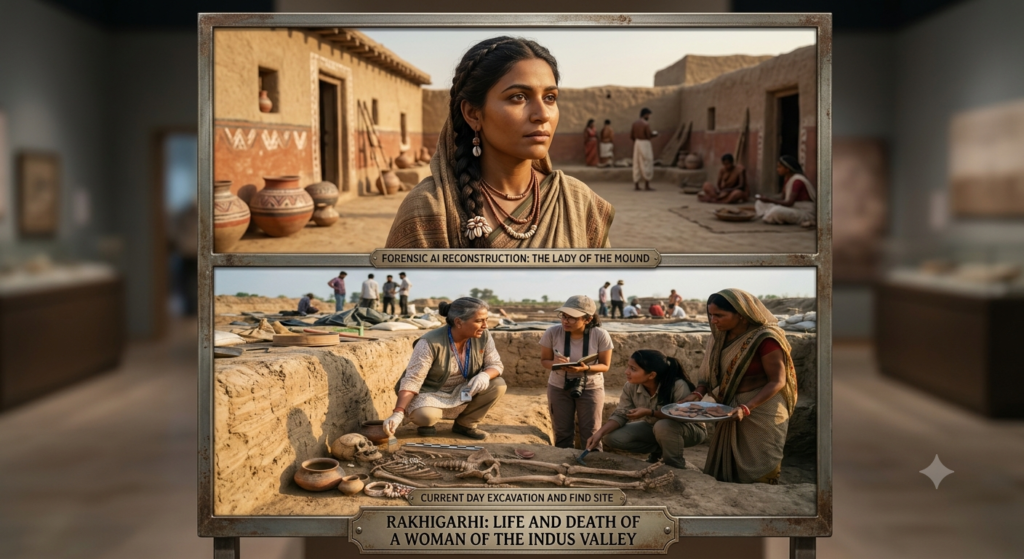
For generations, the urban wonders of the Indus Valley Civilization were shrouded in romantic mystery. We marveled at the grid-planned streets of Mohenjo-daro and the vast brick granaries of Rakhigarhi, but we spoke of their creators as a phantom people—an ancient society that somehow vanished into the sands of time. Sensational internet rumors occasionally resurrected them as mythic giants, spinning tales of six-foot-tall matriarchs uncovered in ancient Haryana. Yet, when modern science finally unlocked the secrets of the buried past, the reality proved far more profound than any internet legend. Through the lens of archaeogenetics, we now know that the Harappans never vanished.
The turning point arrived with the extraction of ancient DNA from skeletal remains at Rakhigarhi, most notably a ~4,600-year-old female specimen cataloged as sample I6113. Groundbreaking research led by an international consortium of scientists succeeded in sequencing her autosomal genome, offering an unprecedented glimpse into the genetic architecture of the Mature Harappan period. The results shattered long-held myths. The ancient genome revealed a specific ancestral substrate—a distinct genetic blend of Ancient Ancestral South Indian hunter-gatherers and early Iranian-related agriculturalists.
When geneticists mapped this ancient profile against present-day populations, the conclusion was inescapable: this “IVC-like” core is the single largest ancestral component shared across virtually every modern South Asian community. From the northern plains to the southern peninsular coasts, across diverse language families and social strata, modern South Asians are the direct biological descendants of the Indus Valley people. The civilization did not end in total demographic catastrophe or population replacement; its inhabitants simply adapted, shifted, and integrated into the evolving tapestry of the subcontinent.
Yet, science is an exacting master that resists simple political narratives. While autosomal DNA proved undeniable continuity, the paternal genetic markers told an equally crucial second half of the story. Sequenced remains from the Rakhigarhi cemetery revealed a total absence of Central Asian Steppe pastoralist ancestry. Crucially, the R1a1 Y-chromosome haplogroup—often informally dubbed the Steppe marker or the Aryan gene—was completely missing from the Mature Harappan genetic pool.
Because Y-chromosomes pass strictly from father to son, tracking paternal lineages requires male skeletons, but autosomal DNA from both sexes independently confirmed that Steppe-related genetic influx had simply not yet reached northwestern India by 2500 BCE. The data indicates that Steppe pastoralist migrations occurred later, around 1500 BCE, as the urban centers of the Indus Valley were waning. When these incoming groups arrived, they integrated into the massive existing Harappan demographic baseline, introducing new paternal lineages alongside the incoming Indo-European language family.
This double revelation provides an objective, scientifically grounded framework for understanding South Asian heritage. It refutes both the notion of a total replacement of indigenous inhabitants and the counter-claim that the Indus Valley was culturally and genetically identical to later Vedic societies. Instead, the South Asian genome is a layered masterpiece. The foundation belongs to the Harappans, while later migrations added new genetic and linguistic threads to an already thriving civilization.
Facial reconstructions performed on Rakhigarhi skulls further humanize this scientific truth. With their high cheekbones, deep-set eyes, and distinct facial contours, the ancient faces reconstructed by forensic scientists look strikingly familiar. They resemble the people walking the streets of modern South Asian cities. Science has stripped away the sensationalism and political polemics to reveal a simple, elegant truth: the builders of the ancient world are not lost to history. NI
Leave a Reply