
We have long imagined our early ancestors as grunting brutes, scraping by on instinct, their lives nasty, brutish, and short. Yet, deep beneath the hills of France and Spain, and in the limestone caves of Indonesia and Australia, a very different picture has been preserved on stone. Thousands of years ago, early humans—and, as we now know, our evolutionary cousins—descended into absolute darkness, built scaffolding, mixed pigments with animal fat, and created masterpieces that would rival any modern gallery. These caves are not mere relics; they are the first museums and the first libraries of the human soul. And thanks to 21st-century science, we are only now beginning to read their true meaning.
Consider the “Big Three” of Europe. In France, the Chauvet cave, over 36,000 years old, offers a world ruled by predators—lions, rhinos, and mammoths rendered with soft shading and a sense of movement that feels almost cinematic. Several thousand years later, the Lascaux cave presents a different menagerie: enormous bulls, galloping horses, and deer, painted with a “twisted perspective” that shows animals in profile while their horns face forward. Meanwhile, in Spain, Altamira dazzles with its polychromatic brilliance, its famous ceiling bison sculpted in multiple shades of ochre. Together, these three sites prove that artistic genius is not a product of civilisation—it is a product of being human.
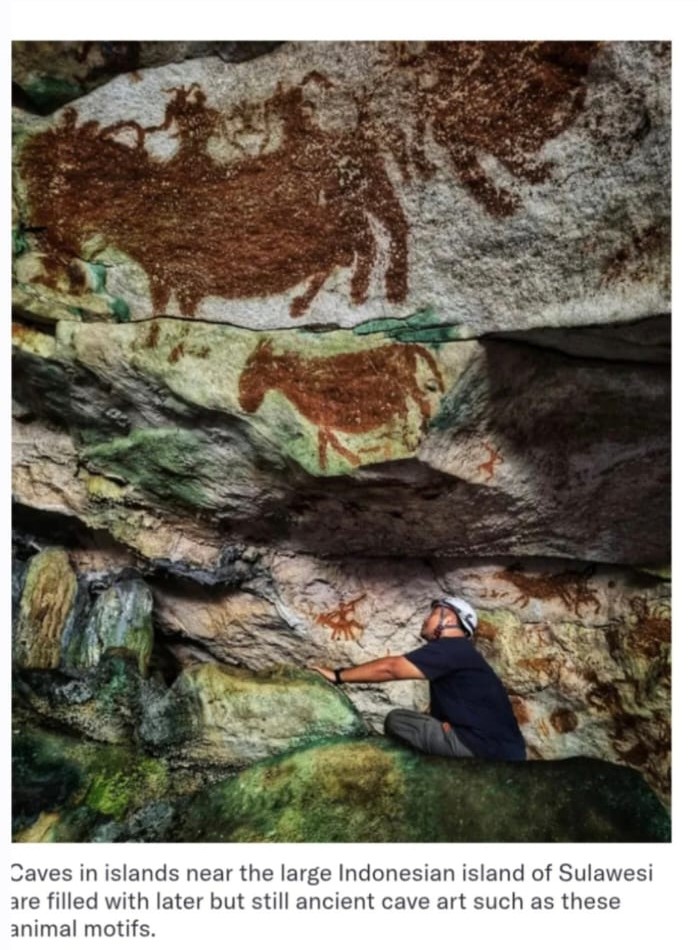
But the European narrative has been dramatically overturned. In the caves of Sulawesi, Indonesia, researchers have discovered a hand stencil dated to at least 67,800 years ago, making it the oldest reliably dated cave art in the world . This is more than 30,000 years older than the cave art found in France . What makes this handprint even more extraordinary is its deliberate alteration—the fingers were narrowed to create a claw-like impression, suggesting a symbolic transformation of the human hand . This art was not a one-off moment of creativity; the Muna cave was used for painting over at least 35,000 years, continuing until about 20,000 years ago . The people who made these marks were likely part of the population that would eventually cross the sea and become the ancestors of Indigenous Australians .
Australia itself holds one of the world’s most impressive and longest-continuing artistic traditions . In Arnhem Land’s Ubirr site, rock paintings range from the earliest periods to works created within living memory, with a sequence spanning from approximately 40,000 years ago to the present . The oldest known Australian Aboriginal figurative rock painting, a kangaroo in the Kimberley region, has been securely dated to between 17,500 and 17,100 years ago using radiocarbon dating of mud wasp nests . These styles evolved in response to major environmental changes, and extensive dating programs continue to provide insights into this rich artistic heritage .
Across these continents, separated by vast oceans and tens of thousands of years, early humans all used a remarkably similar “alphabet” of symbols—red dots, hand stencils, wavy lines, and shield-like forms. The hand stencil is particularly haunting, often showing missing or deliberately bent fingers, likely a form of early sign language or clan marker. The persistence of these symbols suggests a shared neurological grammar—a universal human impulse to abstract the world into symbols, the first stirring of a proto-writing system.
Modern technology is rewriting the history books at a breathtaking pace. 3D scanning has revealed that the most painted areas correspond to acoustic hotspots—places with the strongest echo—proving these caves were ritual theatres where sound and imagery merged . DNA analysis of pigment binders is revealing intimate details of daily life, while Uranium-thorium dating has delivered the most shocking blow to our assumptions: some red hand stencils in Spain are over 64,000 years old, proving that Neanderthals were the original artists of those specific marks.
These discoveries confirm that early human creativity did not emerge in a single place, nor was it confined to Ice Age Europe . The Sulawesi discoveries challenge the long-held view that the earliest cave paintings originated in Europe, forcing scholars to reconsider where and how early symbolic behaviours emerged . When we look at a red handprint on a cave wall, we are looking at a mind that wondered, remembered, and desired. The technology of their creation may have been primitive, but the impulse behind it—to communicate, to codify, to awe—is entirely ours. We are still painting, still leaving our marks on the walls of our world. And, in a very real sense, those first artists are still painting with us.
EK
Leave a Reply