
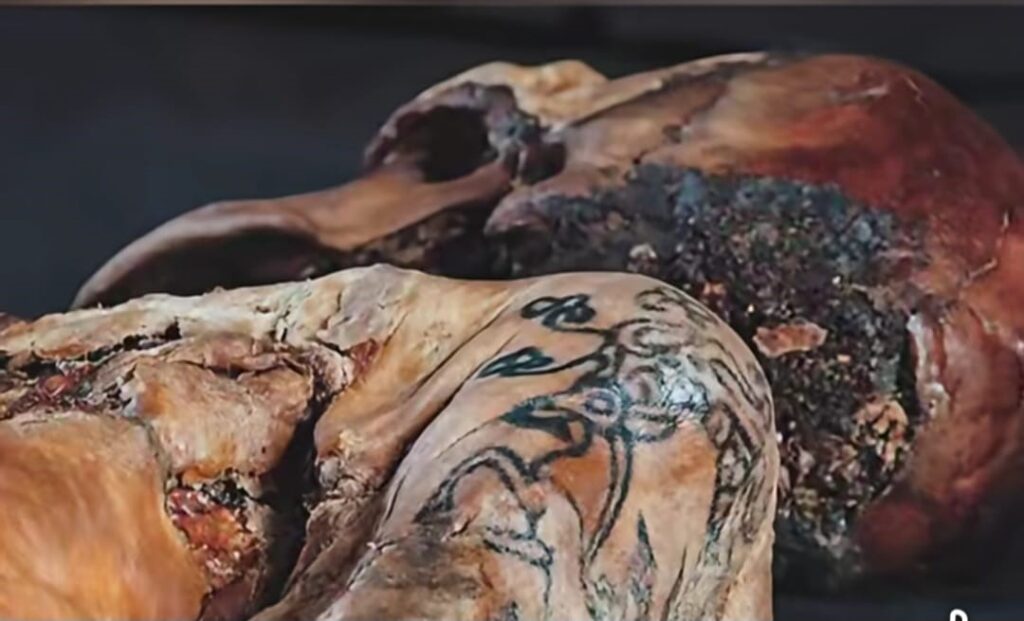
High on the wind-swept Ukok Plateau, where the borders of Russia, China, Mongolia, and Kazakhstan meet, the earth held a secret frozen in time for twenty-five centuries. When archaeologist Natalia Polosmak uncovered a subterranean log chamber in 1993, she did not merely find human remains; she opened a portal into the soul of the ancient Pazyryk culture. Encased in a tomb of solid ice was a young woman, roughly twenty-five years old, whose skin bore some of the most intricate, mesmerizing tattoos ever recovered from antiquity. Dubbed the Siberian Ice Maiden, or the Princess of Ukok, her discovery ignited a global scientific fascination. Yet, her story is far more than a triumph of archaeology. It is a profound meditation on human endurance, spiritual identity, and the uneasy friction between modern scientific curiosity and indigenous reverence.
To look at the Ice Maiden is to realize how little human nature has changed across two and a half millennia. Her body art, preserved with breathtaking clarity by the Siberian permafrost, rivals the craftsmanship of elite modern studios. Etched across her shoulders, arms, and wrists are fantastical creatures, most notably a stylized deer boasting a griffin’s beak and sprawling, flowered antlers, accompanied by panthers and rams. These marks were not crude or haphazard markings. Pazyryk artisans applied soot from hearth fires mixed with animal fats or antiseptics, painstakingly drawing thread soaked in ink beneath the skin or executing precise hand-poke punctures. These tattoos served as visual passports, recording status, spiritual rites, and readiness for the journey into the afterlife.
The grandeur of her burial chamber speaks to a woman held in extraordinary esteem. She was laid to rest in a long-sleeved yellow blouse of wild tussar silk imported from India, a striped wool skirt, white felt stockings, and a magnificent three-foot-tall felt wig adorned with gilded wooden carvings of beasts. Six sacrificed horses, complete with elaborate leather saddles and carved wooden harnesses, accompanied her to carry her across the spiritual divide. She was served mutton on carved wooden tables, her cosmetics nestled in a felt pouch beside a horn comb. Modern magnetic resonance imaging has shed tragic light on her final days. She suffered from advanced bone and breast cancer, enduring immense physical pain that was likely soothed by cannabis, traces of which were found in a vessel at her side. Rather than a royal monarch, she was almost certainly a shaman, healer, or holy woman who transformed her suffering into spiritual authority.
Yet, the moment science pulled her from the ice, a new tragedy unfolded—one of cultural displacement. To the indigenous Altai people, her tomb was not an archaeological site, but a sacred threshold. They revere her as Ak-Kadyn, the White Lady, a guardian priestess placed in the ground to bar the entry of evil forces from the underworld. Her removal was viewed as an act of sacrilege. When devastating earthquakes, severe storms, and economic hardship struck the Altai region shortly after her excavation, locals saw no coincidence. They recognized the fury of a disturbed guardian.
The controversy that followed highlighted the ongoing post-colonial struggle between remote indigenous communities and central authorities. For nearly two decades, her body remained in a research facility in Novosibirsk, prompting fierce protests from Altai elders who demanded her return. While scientists stabilized her using techniques akin to those applied to Lenin, the initial excavation had already caused fungal damage, fueling arguments that her removal was as physically destructive as it was spiritually offensive.
Though she was finally returned to the Altai Republic in 2012 and now rests in a climate-controlled sanctuary at the Anokhin Museum in Gorno-Altaysk, the debate remains unresolved. The Altai people continue to call for her full reburial in the earth of the Ukok Plateau. The Siberian Ice Maiden reminds us that ancient bodies are not merely specimens to be cataloged. They are the ancestral quiet of living cultures, demanding that we weigh our thirst for knowledge against the timeless duty of respect.
Leave a Reply