
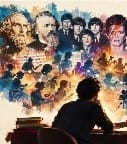
We like to believe in genius. We like the romance of the solitary creator who suddenly sees what nobody else could see and produces something entirely original. Culture has built almost a mythology around such people: Homer, Shakespeare, Mozart, Beethoven, Einstein, the Beatles and David Bowie. We call them geniuses because it is comforting to imagine that extraordinary creativity comes from an extraordinary individual mind. But digital theorist Tony D. Sampson challenges precisely this idea. His provocative proposition is that “natural creative genius” is a myth. Genius, he suggests, is less a possession of an exceptional individual than something that spreads through society.
The idea becomes even more compelling when viewed through Gabriel Tarde’s theory of social contagion. Tarde argued that society advances through imitation. Ideas, habits, behaviours and inventions move from person to person, but they are rarely copied exactly. Each person modifies what he or she receives, producing variations that can then spread further. Creativity, in this sense, resembles evolution. Something already exists; somebody imitates it, changes it, combines it with something else and passes the altered version onwards. What we eventually call an “original” idea may therefore be the latest mutation in a very long chain of cultural transmission.
Harold Bloom’s famous concept of the “anxiety of influence” takes the argument into literature. The great poet, Bloom suggested, does not create in an empty intellectual landscape. He must confront his predecessors, wrestle with their influence and establish his own identity in relation to them. Even the strongest creator is therefore caught in a paradox: to become original, one must first inherit. The new work is simultaneously an act of creation and an argument with the past.
Look at the celebrated names of cultural history through this lens and the mythology begins to change. Homer did not invent storytelling. Whether we regard the Homeric epics as the work of an individual poet or the culmination of an oral tradition, they emerged from a vast inheritance of myths, language, characters and storytelling conventions. Brahms did not invent classical music; he absorbed an immense musical tradition and transformed it. The Beatles absorbed American blues, rhythm and blues, rock ‘n’ roll, skiffle and countless other influences before transforming popular music. Bowie drew upon music, theatre, fashion, literature, visual art and the performers who preceded him. Their achievements were extraordinary, but they were not created in cultural isolation.
This does not make them less creative. It may make their creativity more impressive. Their genius was not that they produced something from nothing, but that they could take material already circulating through culture and recombine it so brilliantly that it became something new. Perhaps originality is not the absence of influence but the ability to transform influence.
There is another uncomfortable part of the argument. Who gets recognised as a genius may depend on considerably more than raw creative talent. Education, wealth, leisure, technology, mentors, publishers, galleries, universities, recording companies and social networks all provide opportunities to develop an idea and make it visible. Two equally imaginative people may produce equally interesting work, yet only one may have the connections and resources necessary to reach a large audience.
History also tends to simplify creative achievement. We remember the Beatles but forget many of the musicians who influenced them; we remember Bowie but not every performer, designer and artist whose work entered his creative universe. The cultural ecosystem disappears and the individual name remains. The genius becomes a convenient shorthand for a process that was actually collective.
There is, therefore, a profound difference between saying that exceptional creative ability exists and saying that “natural genius” exists. Human beings clearly differ in imagination, intelligence, musicality, artistic skill and the ability to make unusual connections. Some individuals achieve things that are genuinely extraordinary. But their originality is never entirely theirs. Every creator inherits a language, a culture, a vocabulary of ideas and a world of influences.
Perhaps, then, genius is better understood not as something one possesses but as something one catches. An idea moves from one mind to another, is altered, intensified and passed on. The exceptional creator becomes a particularly powerful carrier of that cultural contagion.
Genius is a contagion, not a possession. We inherit it, absorb it, mutate it and pass it on. The greatest creators are not those who create without influence, but those who transform influence so completely that we forget where it came from. PT
Leave a Reply