
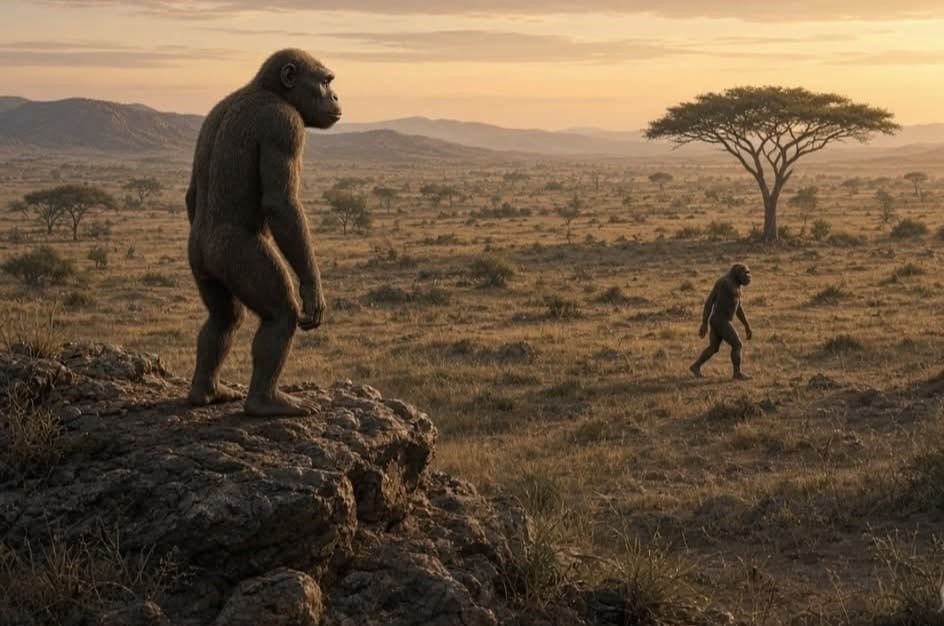
The earliest chapters of the human story are written in the scattered bones of two small, bipedal creatures who lived in Africa some six to seven million years ago. Sahelanthropus tchadensis and Orrorin tugenensis stand at the threshold of our lineage, the first known species that can reasonably be called human in the broadest scientific sense. They were not modern people. They were not a founding couple. Yet they mark the moment when a group of African apes began to walk upright more often than not, setting in motion the long experiment that would one day produce Homo sapiens.
Sahelanthropus tchadensis, discovered in the deserts of Chad and nicknamed Toumaï, lived between seven and six million years ago. Its nearly complete skull shows a mosaic of features: a brain the size of a chimpanzee’s, a sloping face, yet unusually small canines and a foramen magnum positioned in a way that suggests the head was balanced atop a more vertical spine. Later finds of a partial femur have been interpreted by some researchers as evidence of habitual bipedalism, though the claim remains contested. What matters is the timing. This creature lived at or near the evolutionary split between the line that led to chimpanzees and the line that led to us. Whether it sits just on our side of that divide or very close to it, Sahelanthropus is the oldest serious candidate for the first human species.
A little later, around six million years ago, Orrorin tugenensis appears in the Tugen Hills of Kenya. Its name means “original man” in the local language, and its fossils, especially the thigh bones, offer clearer signs of upright walking. The shape and thickness of the femoral neck resemble those of later bipeds more than those of knuckle-walking apes. Like Sahelanthropus, Orrorin retained climbing abilities, moving between trees and open ground in a landscape that was already beginning to fragment. Together these two species form the opening act of the hominin radiation. They lived, reproduced, and died in social groups whose size and structure we can only guess at. But they represent the first known departure from the purely quadrupedal life of the earlier apes.
From that distant starting point the family tree branched rather than climbed. Over the next several million years more than twenty related species appeared. Some, like the various australopiths, flourished for long periods. Others, such as the robust Paranthropus forms, specialized and then vanished. Members of the genus Homo emerged around 2.8 million years ago. Later still came the Neanderthals, the Denisovans, the island dwarfs of Flores and Luzon, and Homo naledi. Many of these were cousins rather than direct ancestors. Our own species, Homo sapiens, is a late arrival, first appearing in the African fossil record roughly 300,000 years ago. The genetic lineages known as Mitochondrial Eve and Y-chromosomal Adam are younger coalescence points within that species.
Evolution works through changing populations across deep time. Sahelanthropus and Orrorin were the earliest known members of the broader human family. They were the first leaves on a bush that would grow crowded with relatives, most of whom would eventually disappear. What these two species give us is a sense of scale and continuity. The human story did not begin with the polished tools or the large brains of later forms. It began with small bipeds testing a new way of moving through a changing world. Everything that followed—the expansion of the brain, the mastery of fire, the spread across continents, the eventual solitude of our own species—rests on that ancient shift. In acknowledging Sahelanthropus tchadensis and Orrorin tugenensis as the first human species, we accept both the depth of our origins and the crowded company in which those origins unfolded. We are the last of a once diverse family, and the first of that family were already walking upright millions of years before any of us arrived. OK
Leave a Reply