
Long before our species walked the Earth, our lineage was already writing its story in the language of food and flame. The narrative of human evolution is not a simple tale of meat-eaters triumphing over vegetarians, but rather a complex journey from the leafy canopies of ancient forests to the flickering glow of a campfire. The earliest members of our family tree, the australopithecines who lived over three million years ago, were predominantly vegetarian. Their diet consisted largely of fruits, leaves, roots, and tough plant materials, a menu that required powerful jaws and large guts to digest. Scientists have confirmed this through isotope analysis of their fossilized teeth, which reveals a diet almost indistinguishable from that of herbivores. However, a profound shift occurred around 2.8 million years ago with the emergence of the genus Homo. These early humans began to incorporate more meat and animal protein into their diets, a change that is considered a critical driver of our evolution. Species like Homo habilis were likely mostly vegetarian but would scavenge meat when possible, while Homo erectus became a true hunter, with animal foods potentially making up a significant portion of their daily calories. Later, the Neanderthals, our close cousins, evolved into largely carnivorous hunters who relied heavily on cooked meat from large game like mammoths and rhinos. Our own species, Homo sapiens, emerged as the ultimate opportunistic omnivore, capable of thriving on a wide range of foods, a flexibility that has allowed us to colonize every corner of the globe.
But diet alone does not tell the whole story. The real turning point, the spark that truly set us on the path to becoming human, was the taming of fire. Fire did far more than simply make meat palatable; it fundamentally rewired our biology and behavior. Cooking is essentially a form of external digestion. The heat from a flame denatures proteins and breaks down tough connective tissues, making meat far easier to chew and digest. This process unlocked significantly more calories and nutrients from the same amount of food, requiring less metabolic energy for digestion. This caloric surplus is widely believed to have been the primary catalyst that allowed our energy-hungry brains to grow larger and more complex. Fire also acted as the world’s first food safety system, killing dangerous parasites and bacteria that would have made raw meat lethal. Because cooking did so much of the digestive work, our bodies adapted over hundreds of thousands of years. Our teeth and jaws shrank as we no longer needed massive chewing muscles, our stomachs became less acidic, and our small intestines grew longer to absorb the sudden influx of easily accessible nutrients.
While the biological benefits of fire are clear, the archaeological evidence for its earliest use is a subject of fierce debate. The most undisputed proof of controlled campfires comes from a remarkable site in Israel called Gesher Benot Ya’aqov, dating back nearly 790,000 years. This site, located on the shore of an ancient lake, is exceptional because it provides a pristine, undisturbed snapshot of early human life. It is not a cave where the remains of countless generations were mixed together, but an open-air location where waterlogged conditions preserved single-event occupation floors. Archaeologists have found distinct hearths with burned wood, seeds, and charred animal bones arranged in clear spatial patterns, leaving no doubt that this was a home base where fire was deliberately tended and used for cooking. This find in Israel does not mean fire was only used there; rather, it reflects the uneven nature of archaeological research and preservation. The region has been subject to intensive study for over a century, while the prehistoric record in neighboring Jordan remains largely unexplored. Furthermore, the site sits on the Levantine Corridor, the primary land-bridge for early humans migrating out of Africa, making it a crucial stop along our ancestors’ journey.
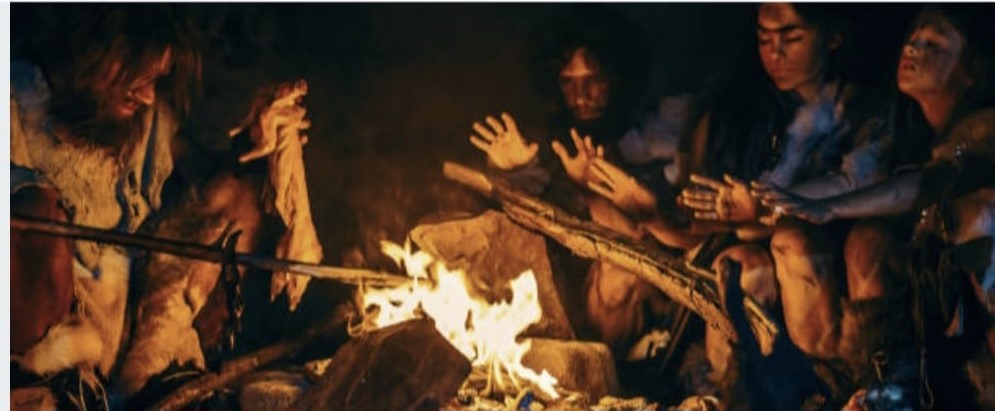
The social impact of the campfire was as transformative as its biological effects. The hearth became a fixed point in the landscape, a home base that anchored nomadic groups and fostered a sense of community. For the first time, our ancestors had a circle of safety that kept nocturnal predators at bay, granting them four to five extra hours of activity after sunset. It is around these fires that anthropologists believe language and storytelling truly flourished, as complex grammar was needed to pass down knowledge and reinforce social bonds in the dark. The need to bring food back to a central fire to cook is also thought to have encouraged the evolution of pair-bonding and a division of labor, where males hunted large game while females gathered plants and tended the hearth. This cooperative interdependence, built over generations of sharing meals, reduced aggression and fostered the generosity that became a hallmark of human society. From the vegetarian australopithecines to the omnivorous modern humans, our story is one of adaptability. But it was the mastery of fire, the ability to gather around a glowing hearth, that truly forged our humanity, turning a simple act of cooking into the foundation of family, community, and culture. EK
Leave a Reply