
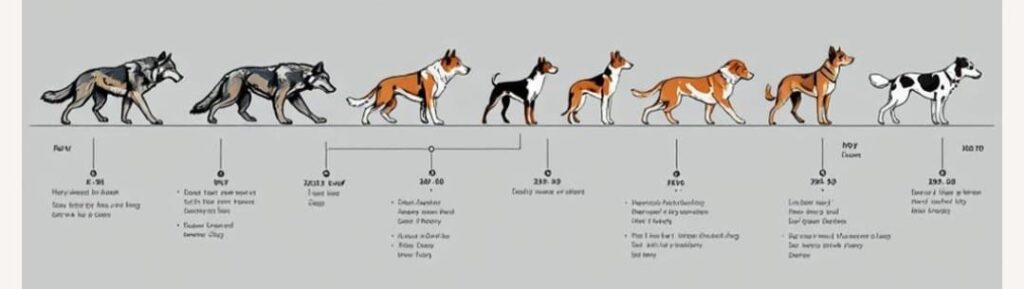
Long before the first seeds were sown in the soil, before humans began cultivating plants and domesticating livestock, a remarkable relationship was forming between people and wolves. Somewhere between 27,000 and 40,000 years ago, during the harsh climate of the Last Glacial Maximum, wolves began lingering near human camps. They scavenged scraps from fires and middens, and those with calmer temperaments found themselves tolerated rather than chased away. Over generations, this tentative coexistence deepened. Humans discovered that wolves could serve as allies in the hunt, their keen senses and speed complementing human strategy. In return, wolves gained reliable food and protection. Slowly, the line blurred between wild predator and trusted partner, and the animals that adapted to human life became something new: dogs.
This transformation was not sudden but gradual, shaped by selective pressures and human choices. Wolves that were less aggressive and more cooperative survived better around people. Over time, their bodies changed too—shorter snouts, smaller frames, varied coat colors. Genetic studies show a clear divergence between wolves and dogs, marking dogs as a distinct species. By about 15,800 years ago, archaeological evidence reveals dog remains buried alongside humans in places like Pınarbaşı in Turkey. These burials suggest not only utility but emotional bonds, a recognition that dogs were more than tools—they were companions.
In early societies, dogs played multiple roles that were essential to human survival. As hunting partners, they increased success rates, helping track and chase prey across difficult terrain. Their presence meant more food security, a crucial advantage in unforgiving environments. As guardians, dogs protected settlements from predators and alerted humans to danger. Their loyalty and vigilance made them indispensable in the fragile stability of early communities. But dogs were not only practical allies. They were companions, woven into the social fabric of human life. The care shown in burials, the evidence of shared diets, and the diversity of dog forms by 11,000 years ago all point to a relationship that was emotional as well as functional.
Beyond survival, dogs entered the realm of culture and spirituality. Across civilizations, they became symbols of loyalty, guardianship, and guides between worlds. In Indo-European mythologies, dogs guarded the gates of the underworld, ensuring souls did not escape. They embodied liminality, existing between life and death, and were linked to celestial symbols like Sirius, the Dog Star, which guided seasonal cycles. In Aztec religion, dogs were buried with humans to guide souls through the afterlife. The god Xolotl, depicted with a dog’s head, was associated with death and rebirth, reinforcing the belief that dogs accompanied humans beyond the grave. In Chinese tradition, dogs were celebrated as one of the twelve zodiac animals, protectors against evil spirits, and guardians at temple entrances. Mythical figures like Panhu, the dragon-dog, highlighted their role as loyal defenders. In India, dogs were companions of deities such as Bhairava and Dattatreya, and they guarded the gates of the underworld alongside Yama, the god of death. Their presence in temple iconography underscored their spiritual significance.
These traditions reveal how deeply dogs were woven into human imagination. They were not merely animals but symbols of trust, guardianship, and the journey between worlds. Their roles in myth and ritual mirrored their roles in daily life: protectors, companions, and guides. The bond between humans and dogs was both practical and profound, shaping survival strategies, settlement patterns, and cultural traditions.
By the time humans began domesticating plants and animals during the Neolithic Revolution, around 10,000 to 12,000 years ago, dogs were already firmly established as humanity’s first domesticated species. They spread alongside human migrations, accompanying people into new lands, including the Americas. Their presence made settlements safer, hunts more successful, and spiritual life richer. Even as societies evolved, dogs remained constant, adapting to new roles—herding, guarding, companionship—while retaining their symbolic power.
The story of dogs in early societies is not just about domestication; it is about partnership. Wolves that could be domesticated became dogs, and in doing so, they reshaped human history. They were hunters, guardians, companions, and spiritual guides. They stood at the edge of the firelight and then stepped into the circle, becoming part of the human family. That bond, forged in the ice and darkness of the Last Glacial Maximum, endures today, reminding us that our relationship with dogs is one of the oldest and most profound connections we have with another species. OT
Leave a Reply