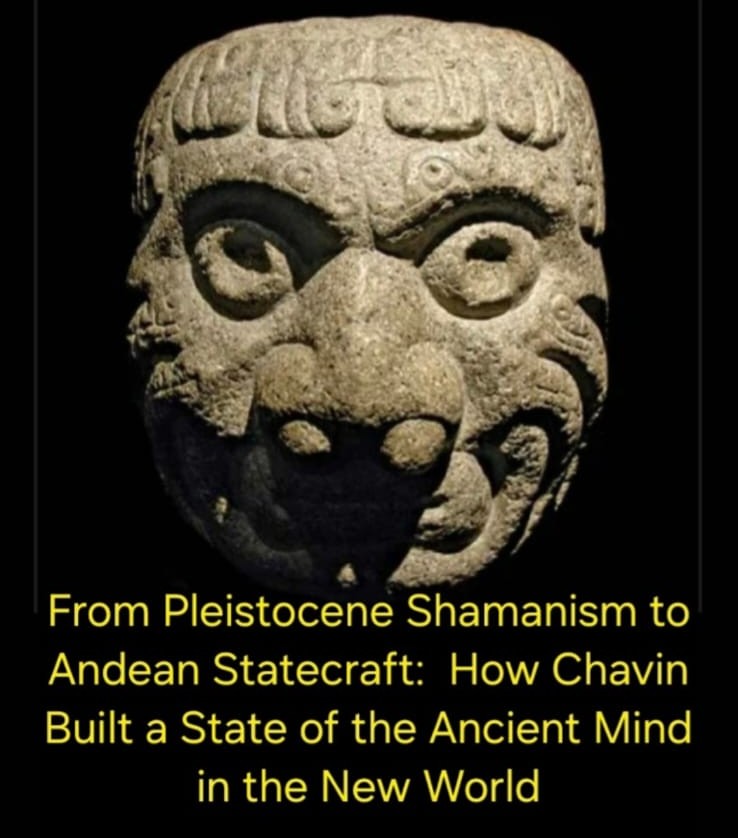
Centuries after the Chavín sphere declined, subsequent Andean civilizations inherited, adapted, and re-engineered these core concepts—evolving from Chavín’s priest-led temple state into powerful militaristic empires, pan-regional trade states, and ultimately the imperial Inca Empire.
Here is how the Chavín religious complex influenced the major Andean civilizations that followed:
1. The Moche (c. 100–700 CE) — From Shamanic Trance to State Ritual & Sacrifice
Located along the arid northern coast of Peru, the Moche expanded on Chavín’s feline and predatory iconography, but shifted the focus from subterranean initiation toward public, state-sanctioned ritual.
- Evolution of Iconography: The Chavín jaguar deity evolved into the Moche “Decapitator” (Ai Apaec), a ferocious feline-human figure with fangs, often depicted holding a ceremonial knife (tumi) and a severed head.
- Militarization of Ritual: While Chavín used psychoactives to bring peaceful pilgrims into an altered state of consciousness, the Moche combined entheogens (like San Pedro cactus) with elaborate combat and ritual sacrifice. Captured elite warriors were sacrificed atop massive adobe pyramids (Huaca del Sol and Huaca de la Luna) to appease the gods and ensure agricultural fertility.
- Elaborate Material Art: Moche ceramic vessels explicitly depicted shamans morphing into owls, jaguars, and sea creatures—direct descendants of Chavín’s Cabezas Clavas (Tenon Heads).
2. Tiwanaku & Wari (c. 600–1000 CE) — The Spread of the Staff God & Portable Paraphernalia
High in the Altiplano around Lake Titicaca (Bolivia) and the central highlands of Peru, the Tiwanaku and Wari cultures codified Chavín’s spiritual symbols into a standardized, pan-Andean iconography.
- The Staff God Transformed: The central deity carved on the famous Gate of the Sun at Tiwanaku is directly descendant from the Staff God seen on Chavín’s Raimondi Stela. Both depict a front-facing deity holding ceremonial staffs terminating in raptor or snake heads, framed by rayed crowns.
- Portable Psychedelic Tools: Tiwanaku perfected the snuffing equipment pioneered at Chavín. Archaeologists have excavated exquisitely carved wooden snuff trays (tabletas) and bone tubes carrying residues of vilca, showing that inhaling psychoactives remained a core requirement for political and religious leadership.
- Lithic Architecture: Tiwanaku adopted Chavín’s tradition of monumental stone carving, sunken courts, and precise subterranean drainage channels that created controlled acoustic environments.
3. The Inca Empire (c. 1438–1533 CE) — Sacred Geography & The Imperial Synthesis
By the time the Inca (Tawantinsuyu) unified the Andes, the ancient Chavín traditions had been woven into the very fabric of Andean life. The Inca institutionalized these concepts on an unprecedented imperial scale.
- Oracular Statecraft: Just as priests at Chavín spoke behind the Lanzón to deliver divine prophecies, the Inca relied heavily on powerful state oracles (such as the Oracle of Pachacamac near present-day Lima). No major military campaign or royal succession occurred without consulting these subterranean oracular shrines.
- Conch Shells (Pututus) as Imperial Tools: The Strombus conch trumpets that resounded through Chavín’s dark galleries became the official signaling instrument of the Inca empire, used by chaski (messenger) runners and during state ceremonies in Cusco’s central plaza.
Key Takeaway
Chavín de Huántar served as the spiritual blueprint for the Andes. While later civilizations added state-sponsored warfare, vast road networks, and imperial administration, the core religious grammar—ancestor worship, sacred geography, sensory-driven ritual, and oracular stone deities—remained remarkably continuous from Chavín all the way to the fall of Cusco.