
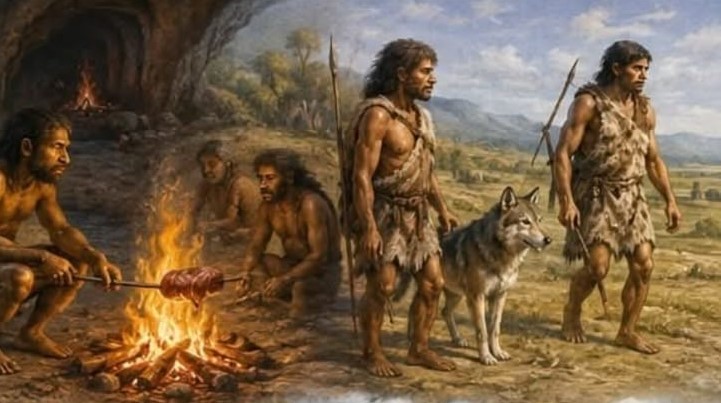
Of all the turning points in human history, few were as consequential—or as ancient—as the mastery of fire. Around a million years ago, Homo erectus were among the early human species associated with controlled fire. We cannot say with certainty that they were the first to tame fire, but their association with fire marks a remarkable stage in human evolution. Fire provided warmth and protection, but its greatest gift may have been something less obvious: cooking.
Roasting meat and heating roots, grains and other foods transformed the human diet. Cooking softened food, made many nutrients more accessible, reduced pathogens and made tough foods easier to chew and digest. More calories could be obtained with less digestive effort. Over evolutionary time, this may have helped support the development of the large, energy-hungry human brain, while our jaws, teeth and digestive system became different from those of other primates.
Fire therefore did more than change what early humans ate. It helped change how they lived. People could remain active after sunset, occupy colder environments and gather around a common source of warmth and food. A technological breakthrough had begun to reshape biology, behaviour and society.
For hundreds of thousands of years after the emergence of Homo sapiens, however, humans remained primarily hunter-gatherers. They moved with the seasons, followed animals, collected plants and survived through an intimate knowledge of nature. Yet they were already extraordinary innovators. They made tools, constructed shelters and used animal hides for protection against cold, wind and rain. Because leather and skin rarely survive archaeologically, the precise history of clothing is difficult to reconstruct, and the use of hides almost certainly predates modern humans in some regions.
Then came another extraordinary partnership: the wolf. At least 15,000 years ago, and perhaps earlier, some wolves began moving closer to human camps. The animals that were less fearful and more tolerant of humans had an advantage around these settlements. Over many generations, this relationship eventually produced the domestic dog. It was not simply a matter of humans deciding to domesticate wolves. It was probably a long process of mutual adaptation in which two social species increasingly benefited from living alongside one another. Dogs became companions, hunting partners, guards and eventually indispensable members of human communities.
But the greatest transformation was still to come. Around 12,000 years ago, humans in several parts of the world began cultivating plants and managing animals. Wheat and barley were domesticated in Southwest Asia; rice in Asia; maize in the Americas; and many other crops emerged through independent domestication elsewhere. Cattle, sheep, goats and pigs were also gradually brought under human control.
Agriculture was not merely a new way of obtaining food. It changed the human experiment itself. Farming produced food surpluses. People who once had to move constantly could settle permanently. Villages grew into towns and eventually cities. Surplus food could support people who did not farm: potters, builders, traders, soldiers, administrators, priests, craftsmen and scholars. Property became important. Land could be owned, inherited and defended. Inequality grew alongside wealth. Governments, taxation, armies and increasingly complex laws became possible.
Agriculture also changed human biology. Diets altered, populations became denser, and living close to domesticated animals created new opportunities for infectious diseases. Human populations adapted genetically to new foods and lifestyles; the evolution of lactose tolerance in some farming populations is one well-known example.
It is tempting to tell human history as the story of kings, conquerors, priests and great civilizations. But the deeper story begins much earlier and belongs largely to anonymous generations. Someone learned to control fire. Someone discovered that food tasted better and became easier to digest when roasted or cooked. Someone fashioned a tool for working a hide. Someone allowed a wolf to remain beside a camp. Someone planted a seed and discovered that it could produce another harvest.
Each discovery was built upon the previous one. For roughly 300,000 years, Homo sapiens has existed, but Cities, writing, states and organized religion are recent chapters in the vast human story. Civilization did not suddenly appear when the first city was built. It was accumulated slowly through countless acts of observation, experimentation, cooperation and adaptation. That is the most humbling lesson of human history. We are not the product of one invention, one civilization or one generation. We are the result of a very long chain: fire changed food; cooking changed nutrition; clothing helped us survive difficult climates; dogs changed our relationship with other species; farming changed the way we lived; and settled communities eventually created civilization.
If fire helped make us human, farming helped make us society. The farmer, therefore, deserves to stand beside the king, warrior, inventor and philosopher in our understanding of civilization. The farmer produced the surplus that allowed others to specialize, cities to grow and civilizations to emerge. Much of the world we inhabit today—from the food on our tables to the cities around us and the institutions that govern us—rests on a revolution that began when our ancestors first learned not merely to find food, but to grow it. PT
Leave a Reply