
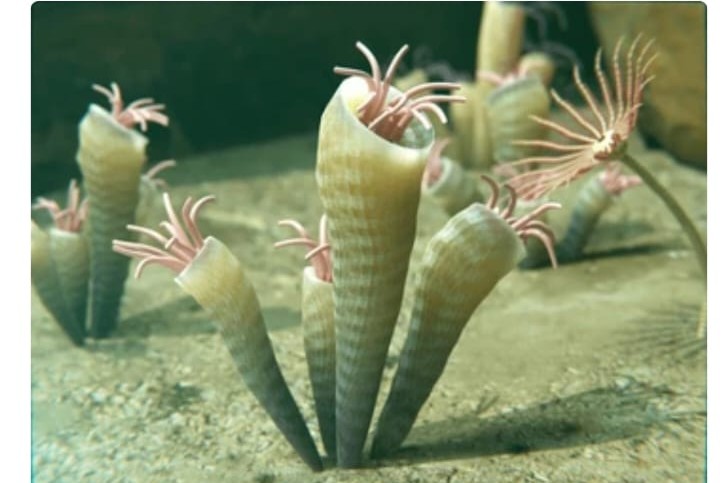
About 470 million years ago, Earth was a profoundly different planet. Life flourished, but almost all of it was confined to the oceans. The seas of the Ordovician Period were crowded with trilobites, brachiopods, mollusks, corals, cephalopods, and some of the earliest vertebrates. Marine ecosystems were undergoing a spectacular diversification, making the oceans the undisputed center of biological activity. Meanwhile, the continents were largely barren expanses of rock, mud, sand, and sediment, with little to suggest the vibrant terrestrial landscapes we know today. [en.wikipedia.org], [britannica.com], [ucmp.berkeley.edu]
Imagine standing on a shoreline at that time. You would not see forests waving in the breeze or hear the sounds of insects and birds. There were no trees, no flowers, no grasslands, and no animals roaming the land. Rivers wound their way across largely lifeless terrain, carrying sediments through landscapes that had yet to be transformed by vegetation. Earth was, in many respects, still a marine planet. [ucmp.berkeley.edu], [en.wikipedia.org]
Yet beneath this apparent emptiness, a revolution was quietly beginning. The first clues come not from spectacular fossils of leaves or stems, but from microscopic spores preserved in ancient rocks. Scientists have discovered fossilized tetrahedral spores dating to the Ordovician, evidence that primitive plants had already begun venturing onto land. These tiny remnants may seem insignificant, but they represent one of the most consequential events in the history of life. [ucmp.berkeley.edu]
The transition from water to land was not simply a change of address. It was a leap into an environment filled with challenges. Aquatic organisms benefited from constant moisture, buoyancy, and relatively stable conditions. On land, survival was far more demanding. Early plants had to find ways to avoid drying out, obtain and distribute water, support themselves against gravity, reproduce without being permanently submerged, and withstand direct exposure to sunlight, wind, and fluctuating temperatures.
These challenges drove a series of evolutionary innovations. Protective outer coverings helped limit water loss. Primitive transport systems gradually improved the movement of water and nutrients. Structural tissues provided support. Reproductive strategies evolved to reduce dependence on standing water. Each adaptation represented a small step forward, but together they enabled plants to establish a permanent presence beyond the water’s edge.
The Silurian Period marked a significant advance in this process. While the earliest pioneers may have appeared during the Ordovician, the Silurian witnessed a broader colonization of terrestrial environments by simple plants. These organisms were small and lacked the sophistication of modern vegetation. They did not yet possess the towering trunks, extensive root systems, or complex leaves that characterize later plants. Nevertheless, they were achieving something remarkable: proving that life could thrive on land. [en.wikipedia.org], [ucmp.berkeley.edu]
What makes this story so important is that the consequences extended far beyond the plants themselves. As vegetation spread across the continents, it began reshaping the very fabric of Earth’s environment. Plant growth helped stabilize soils that had previously been vulnerable to erosion. Organic matter accumulated, creating richer substrates capable of supporting additional forms of life. New ecological niches emerged, attracting fungi and other organisms that could exploit these evolving habitats.
Over time, the presence of plants transformed the continents from barren surfaces into increasingly complex ecosystems. The impacts rippled throughout the biosphere. Once vegetation established itself, opportunities arose for arthropods and, much later, vertebrates to venture onto land. Food webs expanded. Biodiversity increased. Entirely new evolutionary pathways became possible.
The significance of this transformation is difficult to overstate. Without the successful colonization of land by plants, there would have been no forests, no grasslands, and no terrestrial ecosystems capable of supporting the extraordinary diversity of animal life that followed. The Devonian forests that appeared later were built upon foundations laid by these pioneering Silurian and Ordovician plants. Eventually, those developments would help make possible the emergence of amphibians, reptiles, birds, mammals, and ultimately human beings.
Modern discussions of Earth’s history often focus on dramatic events such as mass extinctions, asteroid impacts, or the rise of dinosaurs. Yet the quiet spread of tiny spore-producing plants onto barren continents may have been equally transformative. It lacked the drama of catastrophe, but its consequences were far more enduring. A handful of simple organisms, scarcely noticeable by modern standards, altered landscapes, created ecosystems, and redirected the course of evolution.
From today’s perspective, lush forests and green fields appear natural and inevitable. In reality, they are the outcome of a revolutionary biological conquest that began hundreds of millions of years ago. The fossilized spores preserved in ancient rocks remind us that the modern terrestrial world traces its origins to a modest beginning: the moment when a few pioneering plants first ventured from water onto land and changed Earth forever. OT
Leave a Reply