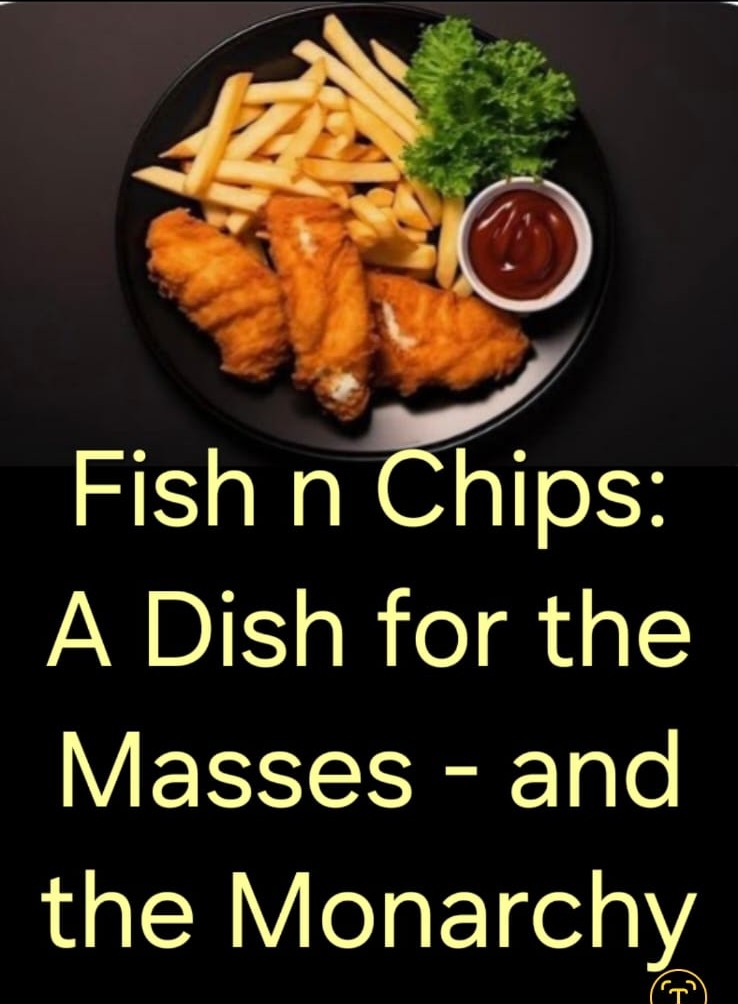
There are few things more British than fish and chips. It is the dish that sustained a nation through wartime, the meal that crosses every class boundary, and the comfort food that has been enjoyed by everyone from factory workers to royalty. But to dismiss it as merely a British institution is to miss a far more interesting story. Fish and chips is not just a national treasure; it is a global traveller, a cultural chameleon, and—believe it or not—a surprising muse for pop music. Its journey from humble beginnings to worldwide phenomenon is a tale worth telling, and it deserves to be recognised as more than just a takeaway.
Let us begin at the beginning, or rather, the contested beginning. The origin of the combined dish is genuinely unclear, and that ambiguity is part of its charm. London claims Joseph Malin, a Jewish immigrant who is said to have opened the first recorded combined fish and chip shop in the East End around 1860. Lancashire counters with John Lees, who supposedly sold fish and chips from a wooden hut in Mossley, near Oldham, around 1863. Some sources even point to Oldham as the site of the first chip shop around 1860. The honest answer is that nobody knows for sure. As one historian put it, several places popped up around the same time, and nobody realised at the time that something important was beginning. What is clear is that by the mid-19th century, fish and chips had emerged as wholesome food at an affordable price—a simple, filling meal for the working masses.
But it was never just for the masses. The dish has a remarkable ability to transcend social strata, and its encounters with the high and mighty are as entertaining as they are revealing. Queen Elizabeth II was a lifelong fan, a taste inherited from her father, King George VI, who would order fish and chips for the family while listening to the radio. Her Majesty, however, preferred a more refined preparation: hake instead of cod or haddock, oven-baked with a panko crust rather than deep-fried in batter, chips cut into perfect rectangles of equal length, and a homemade tarragon hollandaise sauce instead of the traditional tartare. In August 2002, Prince Edward and Sophie, then the Earl and Countess of Wessex, found themselves hungry after a late engagement at Holyrood Palace. With the palace chef gone for the night, they sent a chauffeur in a black limousine to Bene’s chippy on Edinburgh’s Royal Mile for two haddock suppers with plenty of salt and vinegar. And Prince William and Kate Middleton have a favourite chippy from their university days—the Anstruther Fish Bar in Fife—where they were spotted in May 2021 enjoying a £7.85 haddock and chip supper on a bench overlooking the harbour.
Winston Churchill understood the dish’s power perhaps better than anyone. He famously referred to fish and chips as “the good companions” and ensured they were not rationed during the Second World War, believing the meal was vital for national morale. A vivid anecdote from the BBC’s WW2 People’s War archive recounts that while Supreme Allied Commanders—Generals Montgomery, Bradley, and Eisenhower—and Churchill were in Tenby planning the D-Day landings, Montgomery suggested they “go for fish and chips.” They went to a local shop, and a 14-year-old girl famously told the assembled military might to move so she could clear their table—and they did. The dish even served as a recognition signal: during the D-Day landings, British soldiers reportedly used “Fish” and “Chips” as a challenge-and-response password, though the code was reportedly broken by the Germans.
Long before it was a national institution, fish and chips was already making its way into literature. Charles Dickens provides the earliest known literary references to the dish’s components: he mentions a “fried fish warehouse” in Oliver Twist (1839) and gives the first known use of the word “chips” in this context in A Tale of Two Cities (1859), writing of “husky chips of potato, fried with some reluctant drops of oil.” Hollywood legend Cary Grant, born Archibald Leach in Bristol, never lost his love for a humble bag of chips. He was a regular at the Rendezvous takeaway in his hometown, and it is said that when he returned to Bristol, he would even eat his fish and chips sitting in his Rolls-Royce. A diary entry from 1917 shows he once ate fish and chips twice in a single day. And in March 1967, after a gig in Newcastle, Jimi Hendrix bought fish and chips from Marshalls in Tynemouth and sat on a bench overlooking the sea to eat them; the shop still proudly displays a plaque commemorating the visit.
But the real story of fish and chips is not just about famous people eating it. It is about how the dish travelled the world, carried by migrants and adopted by cultures in ways that are often surprising. Australia’s first recorded fish and chip shop was opened not by a Briton but by a Greek migrant named Athanasias Comino in 1879 on Oxford Street in Sydney. Today there are an estimated 4,000 fish and chip shops across the country, using local fish like flake, barramundi, and snapper. In New Zealand, the dish was introduced by British settlers before the First World War, and its cultural impact is perhaps best captured by a famous 1980 photograph of four up-and-coming Labour Party politicians, including future Prime Minister David Lange, eating fish and chips. The image led to the group being nicknamed the “Fish and Chip Brigade,” a moniker that stuck and highlights the dish’s place in the national identity. New Zealanders are such devoted fans that they consume an estimated seven million servings each week.
Ireland’s story is a classic tale of a journey gone sideways. In the 1880s, an Italian immigrant named Giuseppe Cervi was on a ship bound for North America but mistakenly got off at Queenstown (now Cobh) in County Cork. He walked all the way to Dublin, where he began selling fish and chips from a handcart outside pubs. His wife, Palma, would reportedly ask customers, “Uno di questa, uno di quella?” (“One of this, one of that?”). This phrase became so associated with the meal that “one and one” is still a common way to order fish and chips in Dublin today.
In South Africa, fish and chips arrived not through a dedicated shop but through the ubiquitous “corner café” that sold a variety of goods. The early fish and chip shops that did exist were largely the domain of industrious Portuguese immigrants. The modern craze was sparked in 2005 when a franchise called “Old Fashioned Fish and Chips” was created, growing rapidly to 300 outlets and popularising British-style chippies across the social spectrum. Notably, they stuck with local hake rather than the traditional British cod. Other chains like Snoekies, established in Hout Bay in 1951, and Texies also have deep roots in the country.
In the United States, the dish took a different path. In the Northeast and Upper Midwest, it is more commonly known as a “fish fry,” a tradition with strong roots in Catholic communities abstaining from meat on Fridays and in Jewish immigrants who brought the technique of frying fish in oil. Fish and chips as a specific British-style meal did not widely catch on until after the Second World War. In 1969, the actor Arthur Treacher opened his first namesake fish-and-chip restaurant in Columbus, Ohio, helping popularise the concept. On the West Coast, Spud Fish & Chips was started by a British transplant, Jack Alger, in Seattle in 1935.
The global reach of the British appetite for fish and chips even had geopolitical consequences. As cod was the most popular fish for the dish, the British fishing fleet relied heavily on the rich waters around Iceland. When Iceland sought to protect its fish stocks by expanding its territorial waters in the mid-20th century, it led to a series of confrontations with the UK known as the “Cod Wars” (1958–1976). Despite its vastly superior naval power, the UK ultimately lost these conflicts. The dispute was fundamentally about access to the fish that was essential for Britain’s national dish. The dish also left marks in other corners of the world: it was introduced to Hong Kong during the British colonial era, and in the western Norwegian town of Kristiansund, fish and chips has been a local street-food tradition since the 1940s, where it is known as “fishan.”
And then there is the most unexpected chapter of all: the Punjabi song. Arif Lohar’s global hit “Aa” (sometimes referred to as “Aa tenu chips khwawan”) has an origin story tied directly to fish and chips. While rehearsing in London, Lohar casually asked his children to go and fetch some fish and chips from a shop. When they returned, he jokingly said, “Aa tenu chips khwawan” (“Come here, I’ll feed you chips”). That spontaneous, playful line became the seed for the song’s catchy tune. The song went on to amass over 101 million views and was notably featured on the official FIFA World Cup Instagram page in a post celebrating Lionel Messi’s birthday.
So what does all this tell us? It tells us that fish and chips is not merely a British dish. It is a global ambassador, a cultural chameleon, and a surprisingly powerful unifier. It has been enjoyed by queens and rock stars, by wartime leaders and Hollywood legends. It has sparked political nicknames in New Zealand, a diplomatic conflict with Iceland, and a viral Punjabi song. It has travelled with Greek migrants to Australia, Italian migrants to Ireland, and Portuguese migrants to South Africa. It has adapted to local tastes and local fish, from hake in South Africa to flake in Australia to panko-crusted hake for the Queen. It is wholesome food at an affordable price, popular with the masses, yet it has never been confined to the masses. It is the darling of the English-speaking world, but its appeal extends far beyond that. EK