
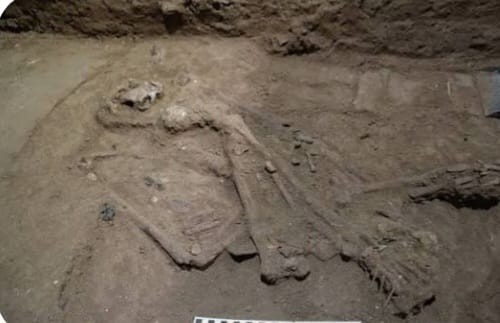
Deep in the limestone karst forests of Indonesian Borneo, inside a humid cavern known as Liang Tebo, archaeologists uncovered a grave that quietly shattered our fundamental assumptions about the rise of human civilization. The skeleton belonged to a young adult Homo sapiens who died roughly 31,000 years ago. What caught the researchers’ attention was the individual’s left leg: the lower third of the tibia and fibula had been cleanly severed by a deliberate, angled cut. It was not the jagged crunch of a crocodile attack, nor the crushing blow of a fallen boulder. It was a surgical amputation—the oldest ever found, predating the advent of agriculture by tens of thousands of years.
Even more astounding than the operation itself was what happened afterward. Osteological analysis revealed that the procedure took place when the individual was a child of ten or twelve. The bone had healed seamlessly, showing years of remodeling without a single trace of fatal infection. The child survived the complex surgery and lived for another six to nine years in the rugged, unforgiving terrain of a Late Pleistocene rainforest.
For over a century, traditional anthropology operated under a cozy assumption: that complex medicine, deliberate surgery, and extended care for the disabled were luxuries of settled life. The standard narrative held that only after humans abandoned nomadic foraging for permanent farming communities could we produce the food surpluses, leisure time, and division of labor required to sustain non-productive members and experiment with advanced healing. Liang Tebo rendered that narrative obsolete. Performing a successful limb amputation in a tropical environment—where heat and humidity make lethal infection almost inevitable—required extraordinary anatomical precision. Someone had to know how to navigate major arteries to prevent fatal hemorrhaging, sever tissue cleanly, and apply effective botanical antiseptics and painkillers derived from the surrounding jungle.
Yet the medical feat is only half the story; the human feat is greater still. A child missing a lower leg in a mobile hunter-gatherer group cannot run, hunt, or easily traverse steep mountain slopes. Living for nearly a decade after such an injury meant that a community consciously chose to carry, feed, protect, and nurture a severely disabled member. They did not abandon the child to the elements.
This discovery does not stand entirely alone; rather, it serves as the capstone to a growing body of fossil evidence proving that long-term social care is a deep, evolutionary hallmark of the human lineage. In the Shanidar Cave of Iraq, the 45,000-year-old remains of a Neanderthal known as Shanidar 1 revealed a man who lived into middle age despite a crushed eye socket that left him blind, a withered and fractured right arm, and a severe limp. More than half a million years ago in Spain, a Homo heidelbergensis child with a severe cranial deformity was nurtured into adolescence. Even earlier, nearly 1.8 million years ago in Dmanisi, Georgia, an elderly Homo erectus survived for years without teeth, relying on companions to pre-chew or soft-process tough meats and wild plants.
Why did our ancient ancestors invest so heavily in those who could not immediately contribute to the physical strain of daily survival? Evolutionary theory points to a powerful mix of genetic preservation, mutual reliance, and cultural memory. In small, closely knit foraging bands, helping a relative preserved shared genes. Caring for the injured also established an essential social safety net; in a hazardous world where anyone could break a leg tomorrow, nursing today’s victim guaranteed your own future care. Crucially, non-hunting elders and disabled band members carried irreplaceable cultural knowledge—where to find hidden water holes during century-level droughts, how to detoxify rare plants, and how to navigate changing seasons.
Ultimately, these ancient bones remind us that compassion is not a modern luxury invented by cities or modern science. Long before we built cities, tilled fields, or wrote down our histories, we held each other’s hands through the dark, bound each other’s wounds, and refused to leave the vulnerable behind. NI
Leave a Reply