
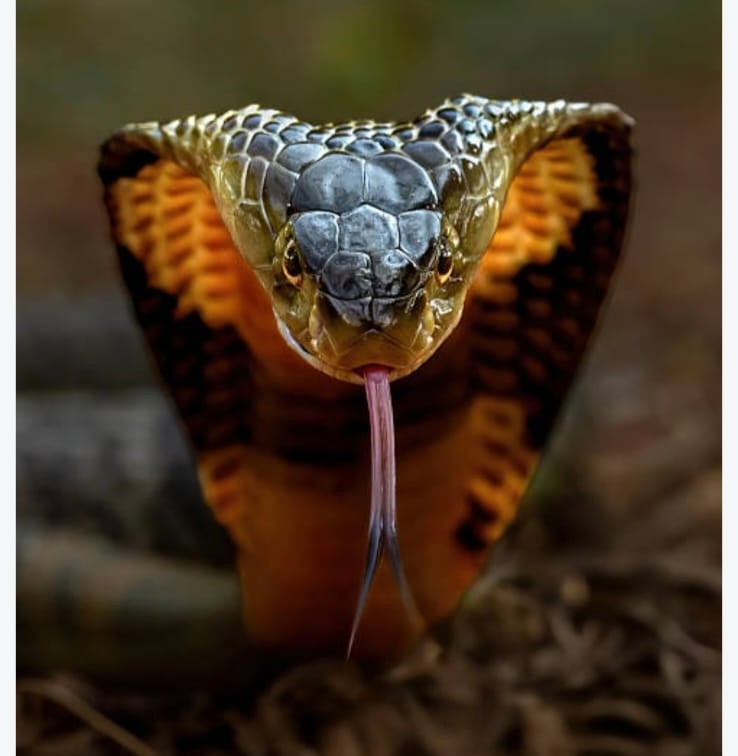
The sudden startle when a coiled shape appears in the grass or a spider skitters across the floor is more than a modern quirk. It is a living echo of deep evolutionary history—one that continues to shape how our brains scan the world.
An Alarm Wired Over Tens of Millions of Years
Long before humans walked upright, our primate ancestors shared habitats with snakes. Constrictors arrived roughly 100 million years ago; venomous species followed around 60 million years later. These animals were cryptic, often motionless, and capable of delivering lethal strikes. Individuals better at spotting them survived to reproduce. Over deep time, that pressure favored neural circuits tuned for rapid detection. The result is a perceptual bias that remains unusually strong in humans and other primates today: we notice snakes and spiders faster than many other objects, even when they are only partially visible or appear in our peripheral vision.
How Snakes Helped Sculpt the Primate Brain
The leading explanation is the Snake Detection Theory. It argues that the need to spot these threats helped drive key primate traits—forward-facing eyes, sharper visual acuity, and specialized brain regions such as the pulvinar. Studies in macaques show that certain neurons in this region fire more strongly and more quickly to images of snakes than to faces, hands, or simple shapes—sometimes by 15 to 25 milliseconds. Even the texture of scales itself acts as a potent visual trigger. Some primate lineages also evolved partial physiological resistance to certain neurotoxins, consistent with an ongoing evolutionary arms race. Spiders, while less central to the core theory, have coexisted with primates for tens of millions of years and elicit similar rapid attentional responses in many people.
Born Ready to Notice, Not Born Afraid
Here the story grows more nuanced. Infants as young as six months already show greater physiological arousal—measured by pupil dilation—to pictures of snakes and spiders than to flowers or fish. They also display preferential looking toward schematic snake forms. Yet this is not the same as innate terror. Careful developmental research finds that young children often attend to these animals without showing clear avoidance or distress. What evolution appears to have provided is a preparedness: an attentional bias plus a learning advantage. Fear of snakes and spiders is acquired more readily—and can be more resistant to extinction—than fear of modern dangers such as cars or electrical outlets. Twin studies suggest moderate heritability for animal fears, typically in the 30–50 percent range. The rest depends on experience: watching a parent flinch, a single startling encounter, cultural stories, or repeated safe exposure that gradually quiets the alarm.
Living With an Old Circuit in a New World
The outcome is a system that still works remarkably well at its original job—flagging potential danger before full conscious analysis—yet is only loosely coupled to full-blown phobia. Many people feel the jolt and move on. Others develop intense aversion. A few keep snakes or spiders as pets. The variation itself is instructive. Evolution equipped us with a sensitive detector and a readiness to learn; culture, individual temperament, and life experience decide how loudly that detector sounds.
That sudden startle, then, is neither pure instinct nor pure learning. It is an ancient preparedness still operating in modern brains—an inheritance that once helped our ancestors survive and that continues, for better or worse, to color how we see the living world around us. OK
Leave a Reply