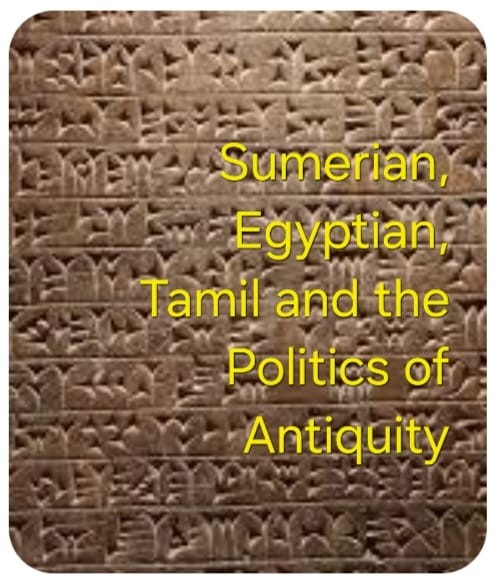
Claims about the “oldest written languages” travel fast: they are satisfying, shareable and often just precise enough to sound authoritative. The trouble is that once you move from slogans to scholarship, the neat triad of Sumerian, Egyptian and Tamil as the world’s oldest written languages starts to fray. Each of these traditions is genuinely ancient and important; each is also ancient in a different way. Sorting out what we can and cannot say about them matters not only for accuracy, but for how we imagine the deep past of writing, language and identity. The image above shows Sumerian alphabet.
Sumerian and Egyptian: the earliest secure writing
On the question of first attested writing, there is broad agreement. Sumerian is widely regarded as the oldest known written language, with clear cuneiform records emerging around 3100 BCE in southern Mesopotamia. Egyptian appears almost as early, with hieroglyphic inscriptions by roughly 3200–3100 BCE and the oldest complete sentence in Egyptian hieroglyphs dated to 2690 BCE. Egyptian also has the longest continuously documented written history of any known language, stretching across more than four millennia.
Both are foundational to the history of writing. Both are also extinct as spoken languages. When people say “oldest written languages still in use,” Sumerian and Egyptian cannot belong in that category; their scripts and languages survive in texts, not in everyday speech.
Tamil: the oldest living literary language
Tamil enters the story differently. It is not a contender for “first writing in the world,” but it is routinely cited as the oldest living languages with a continuous literary tradition. That is a distinct and valuable claim.
The earliest securely dated Tamil inscriptions, written in the Tamili script, belong to the 3rd–2nd century BCE. These include cave inscriptions in Tamil Nadu (for example at Mangulam) and early hero-stone inscriptions such as those from Pulimankompai. Paleographic and stratigraphic studies place Tamil broadly between the 3rd century BCE and the 1st century CE, with some pottery sherds possibly as early as the 4th century BCE at sites like Kodumanal.
The earliest substantial Tamil literature is the Sangam corpus. Most scholars date the historical Sangam period to roughly 300 BCE–300 CE, with many narrowing the core composition to about 100 BCE–250 CE on the basis of linguistic, epigraphic, archaeological and numismatic evidence. The grammar text Tolkāppiyam is usually assigned layers from the late 2nd century BCE onward.
On this basis, Tamil’s securely documented written record spans around two millennia. It is entirely defensible to call Tamil the world’s oldest living literary language.
Tamil a 5,000-years old language
The popular “5,000‑year Tamil” claim usually mixes several different timelines:
- The age of the Dravidian language family: Linguistic reconstructions suggest Proto‑Dravidian may go back roughly 4,400–4,650 years, but that is a reconstructed ancestor, not Tamil as a documented written language.
- Legendary Sangams: Tamil tradition speaks of three ancient academies of poets, the first two supposedly lost to floods and time. These are mytho‑historical; the historical Sangam literature that survives is what can be dated, and it falls within the last ~2,000–2,300 years.
- Recent excavation headlines: Sites like Keeladi, Kodumanal, Porunthal and Sivagalai have produced inscribed pottery and other finds that some reports date as early as the 7th–6th century BCE (for example, ~685 BCE at Sivagalai). These dates are later than 3000 BCE, and they remain debated in terms of context, publication status and interpretation.
Tamil and the Indus script
This is where the Indus Valley Civilization enters the picture. The Indus script (c. 2600–1900 BCE) remains undeciphered, with no bilingual inscription and mostly very short texts on seals and objects. Several prominent scholars—most notably Asko Parpola and Iravatham Mahadevan—have argued that the Indus language was most likely an early form of Dravidian (Proto‑Dravidian), and they have proposed readings on that assumption.
Within that framework, Tamil is sometimes invoked as a major, well‑documented Dravidian language that might preserve distant echoes of the Harappan linguistic world. Anyhow more than a century of work and over a hundred decipherment attempts, there is no consensus on the Indus script, despite the fact that some leading specialists argue that the Indus script most likely records an early Dravidian language, which would make Tamil’s family a relative of the Harappan tongue.
Why precision matters
These distinctions are not pedantry. They shape how we understand:
- The history of writing: Sumerian and Egyptian show us the emergence of full writing systems in the fourth millennium BCE. Tamil shows us the endurance of a literary language across two millennia and counting.
- The politics of antiquity: Claims of “5,000‑year” continuity or direct links to the Indus script often serve contemporary identity projects.
- What “oldest” actually means: Oldest written language? Oldest living language? Oldest continuous literary tradition? Each question has a different answer, and each answer points to different civilizations and achievements.
Precisely it can be said that Sumerian and Egyptian are the earliest attested written languages, with clear records from the fourth millennium BCE, and Tamil is the oldest living language with a continuous literary tradition, securely attested in inscriptions and texts though some scholars hypothesize that the undeciphered Indus script records an early Dravidian language.
Leave a Reply