
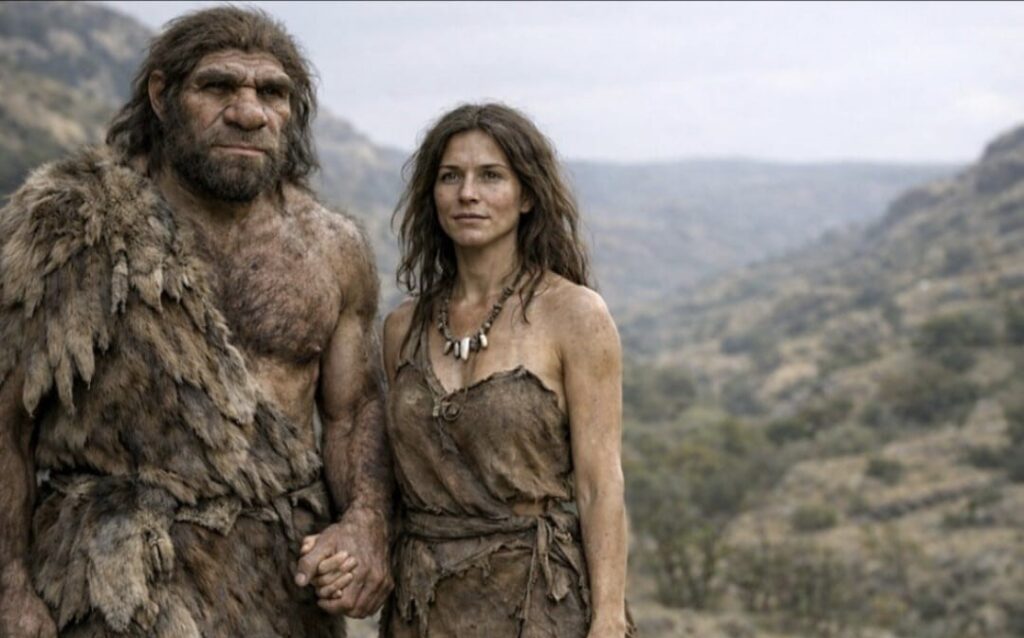
For much of modern history, the story of human evolution was told as a procession. One species emerged, another disappeared, and Homo sapiens marched onward as the uncontested successor. Neanderthals occupied an earlier rung on the evolutionary ladder: strong, adapted to Ice Age Europe, and ultimately defeated by our supposedly superior ancestors.
That story is now impossible to defend in its simple form. Neanderthals did not merely vanish. They met Homo sapiens, exchanged genes with them, and became part of the ancestry of people alive today. Yet the genetic legacy of that encounter is not evenly distributed across the human genome. The most intriguing clue may be what is missing: no known present-day human Y haplogroup can be confidently identified as a surviving Neanderthal paternal lineage.
The evidence for interbreeding is no longer speculative. Most people whose ancestry lies outside Africa carry approximately 1–2% Neanderthal-derived DNA. These fragments are scattered through the genome, and some influence biological processes involving immunity, skin, hair and environmental adaptation. Neanderthal ancestry is therefore not an abstract footnote in a genetics textbook. It is part of the biological inheritance of billions of people.
Recent genomic research also suggests that the exchange may have been strongly sex-biased. The surviving pattern is most consistent with Neanderthal males fathering children with Homo sapiens females more often than Homo sapiens males fathered children with Neanderthal females. This conclusion does not mean that prehistoric relationships followed a single social script, nor does it allow us to reconstruct individual encounters. Genetics cannot tell us whether these unions were consensual, forced, socially accepted or exceptional. It can reveal only which forms of ancestry survived and multiplied.
The X chromosome provides an important clue. Because males possess one X chromosome and females possess two, ancestry inherited through different male and female pathways leaves distinctive genetic signatures. Neanderthal ancestry is unusually scarce on the human X chromosome, while Neanderthal X chromosomes contain an excess of modern-human ancestry. This asymmetry fits a history in which Neanderthal men and Homo sapiens women contributed disproportionately to later mixed populations.
The Y chromosome presents an even more paradoxical story. A Neanderthal man who fathered a son with a Homo sapiens woman would have transmitted his Y chromosome to that son. Yet no such Neanderthal Y lineage is known among living human males. This does not disprove Neanderthal male–Homo sapiens female unions. A paternal line can disappear through demographic chance, reproductive disadvantage or later population expansion.
More remarkably, the available evidence suggests that the original Neanderthal Y chromosome itself may have disappeared from later Neanderthals. Between roughly 370,000 and 100,000 years ago, a Y chromosome related to an early modern-human lineage may have entered Neanderthal populations and eventually replaced their older paternal line. In other words, Neanderthal men may have contributed genes to Homo sapiens, while Homo sapiens-related genes also transformed the Neanderthal male lineage.
Grotte Mandrin in southern France gives this genetic story an archaeological setting. The cave preserves evidence that Homo sapiens reached the region around 54,000 years ago—far earlier than the once-accepted date for their widespread arrival in Europe. Neanderthal and modern-human occupations appear to have alternated there, suggesting repeated movements, brief settlements and unstable coexistence rather than one clean invasion.
This matters because evolution is not a morality play. Homo sapiens did not simply defeat an inferior species, and Neanderthals were not sealed-off primitives awaiting extinction. They were a closely related human population with its own adaptations, technologies and social lives. Their disappearance as a distinct population resulted from a complicated combination of climate, demography, competition, isolation and assimilation.
The Neanderthal story therefore unsettles not only our science but also our self-image. Human evolution was not a straight line leading inevitably to us. It was a tangled history of migration, separation, contact, reproduction and loss. We are the surviving branch, but we are not an untouched branch. Part of the Neanderthals lives in our genomes—and perhaps the most revealing evidence is found in the paternal lineage that did not survive.
TY
Leave a Reply