
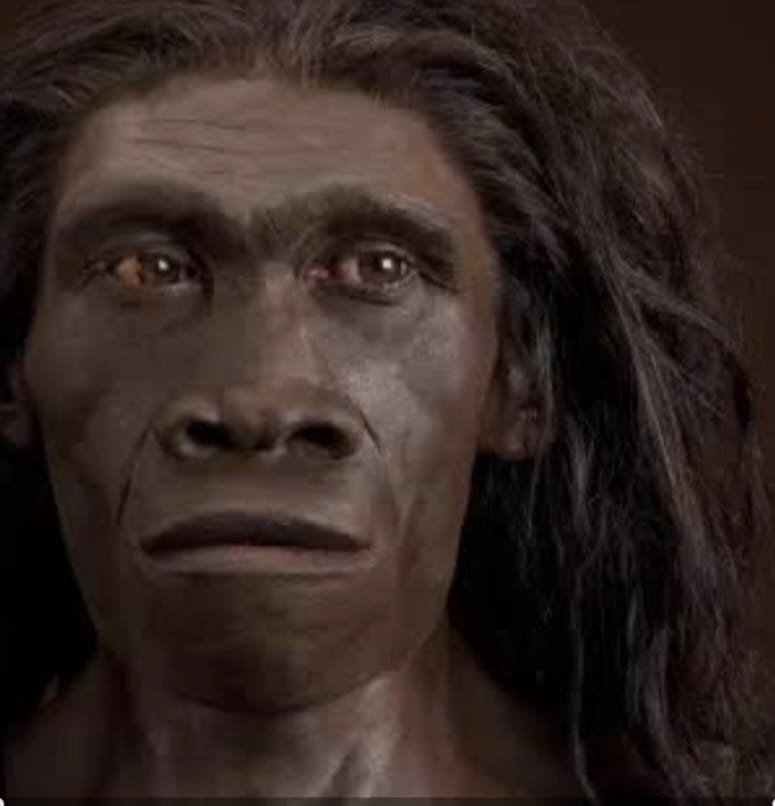
For nearly two million years, Homo erectus walked the Earth, a species whose endurance and ingenuity made them one of the most successful hominins in history. They were not merely primitive ancestors but pioneers of adaptability, innovation, and survival strategies that shaped the trajectory of human evolution. Their story is not just about survival; it is about laying the foundations for what we now call humanity.
Imagine a day in the life of Homo erectus. At dawn, small bands of families stirred near rivers or forest edges, where water and food were accessible. The men and women prepared for the hunt, not with bows or spears but with carefully crafted Acheulean handaxes — multipurpose stone tools that reflected planning and foresight. Hunting was not a solitary endeavor; it was a coordinated pursuit. Persistence hunting, where prey was chased until exhaustion, was a hallmark of their strategy. This required stamina, cooperation, and an understanding of the environment. When the kill was made, the group gathered to butcher the animal, sharing the meat among themselves. This act of communal sustenance reinforced bonds and ensured survival.
Fire was their revolutionary breakthrough. Around the flickering flames, Homo erectus cooked meat, making it safer and easier to digest, unlocking more calories to fuel their expanding brains. Fire was warmth against the chill of night, protection from predators, and a social hearth where stories — perhaps rudimentary gestures or vocalizations — were exchanged. It was here that culture began to take root, in the glow of flames that transformed survival into community.
Their shelters were simple, built from branches, hides, or caves when available. Yet these structures symbolized something profound: the ability to manipulate the environment for comfort and safety. Children played under the watchful eyes of elders, learning the skills of toolmaking and hunting. Cooperation in raising offspring was essential, as survival depended on shared responsibility. This social fabric was the glue that held Homo erectus together across continents and climates.
Adaptability was their greatest strength. From the savannas of Africa to the forests of Asia and the colder regions of Europe, Homo erectus thrived. They were the first hominins to leave Africa, spreading across Eurasia, leaving fossils in places as far-flung as Indonesia and China. Their ability to adjust to new environments was not accidental; it was the product of innovation and resilience. They were explorers long before Homo sapiens, charting paths that would later be followed by their descendants.
Yet survival was not eternal. Around 900,000 years ago, Homo erectus faced a catastrophic bottleneck. Climate upheaval during the Mid-Pleistocene Transition reduced their numbers from about 100,000 to only 1,280 breeding individuals. For over 100,000 years, they teetered on the edge of extinction. That they endured at all is a testament to their resilience. But this bottleneck also shaped their genetic legacy, reducing diversity and setting the stage for evolutionary branching.
In Africa, Homo erectus populations gradually evolved into Homo sapiens. Brain size expanded, symbolic thought emerged, and culture flourished. In Europe, Homo erectus gave rise to Homo heidelbergensis, which in turn evolved into Neanderthals — robust, cold-adapted humans who thrived in Ice Age conditions. In Asia, some populations became Denisovans, a mysterious lineage known mostly through DNA, yet whose genetic imprint survives in modern humans today. Tibetans thrive in thin mountain air because they inherited a special variant of the EPAS1 gene from Denisovans. Homo erectus was not a dead end; they were the trunk of the evolutionary tree from which multiple branches grew.
Their disappearance was gradual, not sudden. By about 110,000 years ago, the last known Homo erectus fossils in Java mark the end of their astonishing run. But their legacy endures in every human alive today. The fire they tamed, the tools they crafted, the social bonds they nurtured — these were the building blocks of humanity. Without their adaptability, innovation, and survival strategies, the story of Homo sapiens might never have been written.
Reflecting on Homo erectus is more than an exercise in anthropology; it is a reminder of the fragility and resilience of human existence. They survived climate upheavals, scarcity, and near extinction, not through brute strength alone but through cooperation, ingenuity, and adaptability. In an age where humanity faces its own existential challenges — from climate change to resource scarcity — the lessons of Homo erectus resonate. Survival is not guaranteed, but innovation and cooperation remain our greatest tools.
The story of Homo erectus is not just ancient history. It is a mirror held up to our own Eight Billion Plus species, reminding us that endurance is born of adaptability, that progress is forged in innovation, and that survival is secured through community. They walked the Earth for two million years. Their footsteps echo in ours.
Leave a Reply