
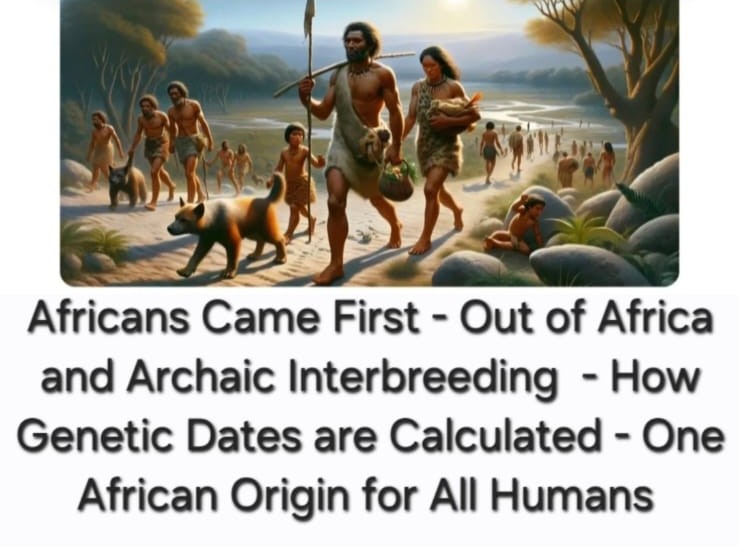
Human Origins, Migration, and the Stories Our Genes Tell
We are all African. That is not a slogan. It is the conclusion of decades of fossil, genetic, and archaeological evidence. Yet misconceptions persist—some innocent, some ideological. Among the most stubborn is the notion that Europeans somehow pre-dated Africans, or that the biblical-sounding “Mitochondrial Eve” and “Y-chromosomal Adam” were a founding couple. Neither is true. What the science actually reveals is stranger, richer, and far more unifying than any myth.
Europeans Pre-Dated Africans?
No. The evidence is overwhelming: our species, Homo sapiens, arose in Africa, and Europeans are the descendants of a later migration out of that continent.
The oldest fossils of anatomically modern humans come exclusively from Africa. The earliest known specimens, from Jebel Irhoud in Morocco, date to roughly 315,000 years ago. Others from Ethiopia and South Africa follow. The oldest Homo sapiens fossils in Europe, by contrast, date to only about 45,000 years ago—more than five times younger.
So where does the confusion come from? From other, more archaic humans. Homo erectus and related species left Africa as early as 1.8 million years ago and reached Spain over a million years ago. Neanderthals evolved in Europe and lived there until about 40,000 years ago. These were not modern Europeans. They were different human species, later replaced by Homo sapiens arriving from Africa. The Europeans did not pre-date Africans. They descend from them.
Out of Africa: The Great Dispersal
The “Out of Africa” model describes how modern humans left their African homeland and populated the world. The main genetic evidence points to a successful dispersal around 60,000 to 70,000 years ago, based on the age of mitochondrial lineages from which all non-African maternal lines descend.
Two main models compete. The single dispersal model envisions one major migration via a southern coastal route across the Red Sea, along the coast of India and Southeast Asia. The multiple dispersals model proposes several waves, with an early departure perhaps 130,000 years ago whose descendants include the isolated ancestors of Australo-Melanesian populations, followed by a later push into northern Eurasia around 50,000 years ago.
Both models remain under investigation. What is not in doubt is the direction: out of Africa, not into it.
Neanderthal Interbreeding: We Carry Their Ghost
As modern humans spread out of Africa, they met and interbred with archaic humans—most notably Neanderthals and Denisovans. This admixture is now firmly established by ancient DNA.
All present-day non-African people carry roughly 1–2% Neanderthal DNA. These surviving genes are not random; they cluster around metabolism and immunity, likely helping early humans adapt to new climates and pathogens. The main interbreeding event occurred between 45,000 and 50,000 years ago, probably in the Middle East. A separate mixing with Denisovans left 2–5% Denisovan DNA in Melanesians and Aboriginal Australians.
How Genetic Dates Are Calculated
When scientists say Mitochondrial Eve lived about 200,000 years ago, or Y-chromosomal Adam roughly 180,000–300,000 years ago, they rely on two tools: the molecular clock and coalescent theory.
The molecular clock assumes DNA accumulates mutations at a roughly constant rate. By counting differences between two sequences and dividing by a calibrated mutation rate, scientists estimate when they shared an ancestor. Calibration uses known events—the human-chimpanzee split, or measured pedigree mutation rates. Mutation rates are often expressed per site per year and must be combined with generation time to yield calendar dates.
Coalescent theory then models how lineages merge as you trace them backward. For mitochondrial DNA, passed only from mother to child, all living humans belong to one maternal lineage that coalesces into a single ancestor. For the Y chromosome, passed father to son, the same logic applies. These coalescence times depend on mutation rate and effective population size. Ancient DNA from fossils now provides “tip calibrations”—directly dated points on the tree—sharpening these estimates.
There is also the autosomal most recent common ancestor, the point where all our family trees merge when looking at the whole genome. That person lived much more recently and could have been male or female. Not Mitochondrial Eve. Not Y-chromosomal Adam. A different, anonymous ancestor entirely.
The Unity Beneath the Skin
The real story is not of separate races with separate origins. It is of one African homeland, one species, and a long, messy journey across the world. Mitochondrial Eve and Y-chromosomal Adam were not a couple. They were not the first humans. They were two threads in a vast tapestry, whose lines happened to survive.
Europeans did not pre-date Africans. Africans pre-date everyone. And every living person—whatever their skin, language, or passport—carries the inheritance of that African dawn. That is not politics. That is genetics.
Leave a Reply