
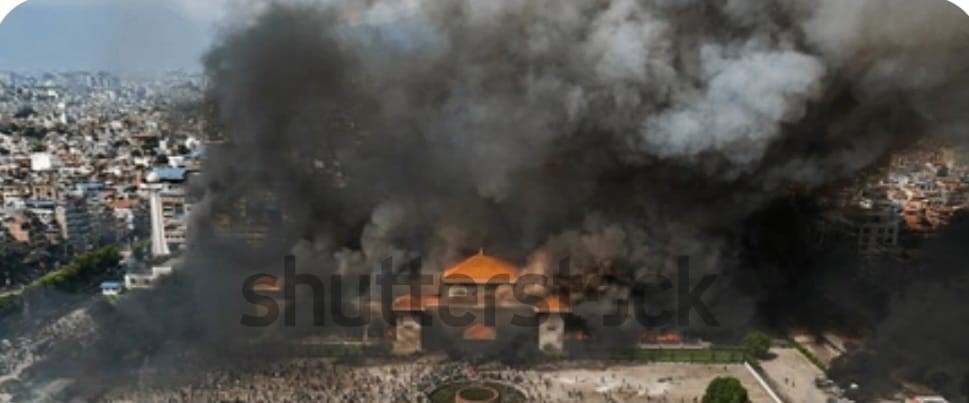
The southern border plains of Nepal, a region historically known as the Terai-Madhesh, are once again engulfed in a volatile mix of communal violence and deep-seated political identity struggles. The recent eruption of unrest in late July 2026, sparked by seemingly minor local disputes over loud music and the replacement of a community flag on an electricity pole, quickly transformed into violent clashes. As mobs engaged in looting and arson, the secular Nepalese state responded with firm security measures, deploying the Nepali Army and imposing strict curfews. When security forces used live ammunition to quell the escalating riots, three individuals—all associated with the Hindutva-led mobilisation—were killed in Sunsari and Siraha districts. This heavy-handed state intervention has triggered a direct stand-off between hardline Hindutva demonstrators and the state security apparatus. Beneath the immediate smoke of burning businesses lies a deep-rooted dispute over demographic representation, political legitimacy, and historical engineering. For decades, official census data has classified nearly 81 percent of Nepal’s population as Hindu. However, secular analysts, indigenous leaders, and Dalit activists argue that this sweeping monolithic statistic is a relic of previous autocratic regimes that enforced cultural assimilation. Historically, under the absolute monarchy and strict legal codes like the 1854 Muluki Ain, diverse Buddhist, animist, and indigenous communities—the Adivasi Janajati or mool nivasis—were systematically integrated into the lower rungs of the Hindu caste hierarchy, often designated as Shudra or marginalized castes. This historical state engineering sought to construct an artificial, unified religious canopy that inherently privileged the traditional ruling elite. This traditional elite is composed primarily of Hill Brahmins and Chhetris, who together constitute roughly 28 percent of Nepal’s total population. Despite their minority demographic status, this elite group has historically maintained an absolute monopoly over the country’s political parties, civil bureaucracy, judiciary, and military. Critics argue that the majoritarian slogans currently being chanted by hardline Hindutva groups are strategically fake. By framing localized disputes as existential crises for the majority religion, these organizations—frequently operating under local front groups like the Hindu Samrat Sena—attempt to project an “us versus them” narrative. The primary political goal of this strategy is to foster an aggressive religious identity that supersedes caste and ethnic divisions. By doing so, they hope to pressure the indigenous, Dalit, and Shudra majority, who make up the remaining 72 percent of the country, to fall back under a monolithic Hindu identity, thereby preserving the traditional caste-based social and political hierarchy. However, the contemporary political landscape of Nepal makes this assimilation strategy increasingly difficult to sustain. The historic, youth-led “Gen Z” uprising in September 2025 radically disrupted the status quo, forcing the resignation of the old political guard and dissolving the traditional power structure. In the subsequent political alignment, a new generation of leaders has emerged, bringing the historically marginalized majority into unprecedented positions of leverage. The current Prime Minister, Balendra “Balen” Shah, hailing from the Madhesi community, embodies this shift away from the Hill Brahmin monopoly, leading a fragile and pluralistic federal coalition of regional parties, indigenous Janajati fronts, and secular youth factions. This current communal explosion is therefore viewed by social scientists as a direct conservative backlash against the political awakening of the Shudra and indigenous majority. As these historically marginalized groups increasingly assert their secular, identity-based rights under the country’s federal structure, hardline factions are escalating their tactics to manufacture a “Hindu-in-danger” panic. The open border with neighboring India has allowed these groups to draw ideological inspiration, rhetoric, and social media polarization strategies directly from broader subcontinental majoritarian movements. While proponents of a Hindu state argue they are merely preserving a historical, civilizational identity against foreign secular influences, indigenous and Dalit organizations view the movement as an existential threat to their hard-won autonomy. The ongoing state-enforced lockdowns along the southern trade corridors reflect a nation caught in a profound transition: a secular government attempting to maintain neutral law and order while a newly empowered, diverse majority resists the structural re-imposition of a historical, minority-led religious hierarchy.
Leave a Reply