
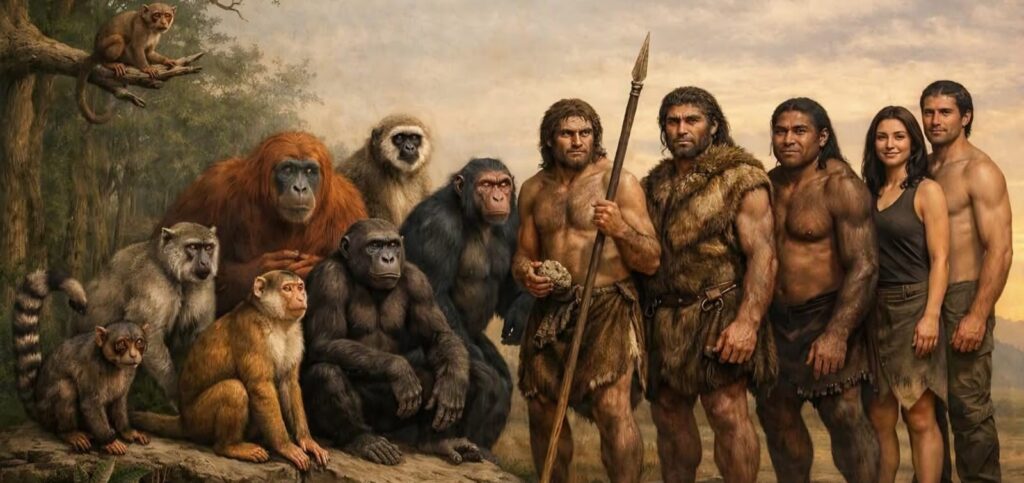
The origins of our species are not a simple tale of linear progress, but a tangled narrative stitched together from fossils, artefacts, DNA, and climate records. For decades, scientists imagined a straightforward march from ape-like ancestors to modern humans. Yet the pace of discovery in recent years has shattered that neat picture, revealing instead a mosaic of species, overlapping timelines, and unexpected twists.
Primates themselves emerged long before Homo sapiens, somewhere between 85 and 55 million years ago. Genetic studies push their divergence back even further, suggesting they were already evolving before the asteroid strike that ended the Cretaceous Period 66 million years ago. That cataclysm wiped out the dinosaurs, but it also opened ecological niches for mammals to flourish. Within just 100,000 years, small creatures like Purgatorius appeared in North America. These plesiadapiforms were not “true” primates, but they were close relatives, with teeth adapted for fruit and insects and bodies suited to arboreal life. They represent the first tangible step toward the primate lineage that would eventually lead to us.
The fossil record, however, is notoriously incomplete. Small-bodied mammals rarely fossilize, and geological processes erase much of what once existed. This is why genetic clocks often suggest earlier divergence dates than fossils can confirm. The tension between DNA evidence and physical remains is a reminder that science is always provisional, always working with fragments of a much larger story.
By the Eocene epoch, around 55 million years ago, the first true primates — Euprimates — had emerged. They carried the hallmarks of the order: stereoscopic vision, grasping hands, nails instead of claws. Fossils like Notharctus and Adapis show the diversity of these early primates, split into adapiforms (probable ancestors of lemurs and lorises) and omomyiforms (possible ancestors of monkeys and apes). Later, simiiforms such as Eosimias in Asia hinted at the beginnings of the monkey and ape lineages.
Fast forward tens of millions of years, and the human family tree itself becomes increasingly complex. Discoveries like Homo naledi in South Africa, Homo floresiensis in Indonesia, and the Denisovans in Siberia have revealed that multiple hominin species coexisted, sometimes interbreeding, sometimes innovating independently. Ancient DNA has been crucial here, showing that our lineage is not a straight trunk but a braided stream, with genetic contributions flowing from Neanderthals, Denisovans, and perhaps others into modern humans.
Archaeological artefacts add another dimension. Stone tools, ornaments, and cave art reveal cognitive leaps and cultural practices, but they also raise questions. When did symbolic thought first appear? How long did traditions last? The gaps in the record make it difficult to determine when innovations began or ended. Climate data helps fill in some blanks, showing how shifts in environment spurred migrations and adaptations. The expansion of tropical forests after the K-Pg extinction, for instance, created habitats that favored arboreal primates. Later, ice ages and warming periods pushed hominins to move, invent, and survive in new ways.
What emerges is a story of resilience and contingency. Our species did not evolve in isolation but in dialogue with other hominins, with ecosystems, and with chance events like asteroid strikes and climate upheavals. Each new fossil, each strand of DNA, each sediment core adds nuance, complicating the narrative but also enriching it.
The incomplete record is not a weakness but a challenge — a reminder that science is a process of reconstruction, inference, and debate. It is like piecing together a novel from torn pages: the plot is visible, but the details are elusive. And yet, with every discovery, the story of our origins becomes more vivid, more tangled, and more profoundly human.
Leave a Reply