
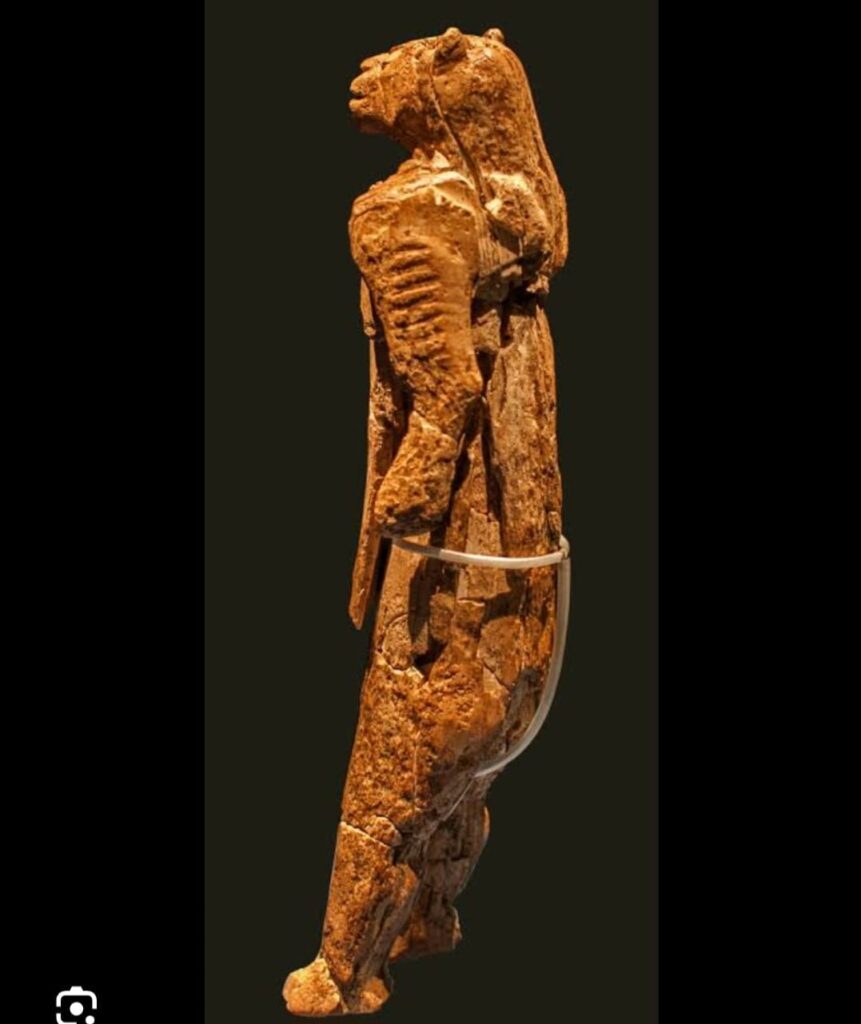
In a cave in southern Germany, sometime around 40,000 years ago, someone picked up a piece of mammoth ivory and a flint knife and carved a figure that had no business existing in nature: a creature with a man’s body and a lion’s head. It took the better part of a century, after its 1939 discovery, for archaeologists to even reassemble the roughly 200 fragments into the 31-centimetre statuette now known as the Löwenmensch, the Lion-man of Hohlenstein-Stadel. Carbon dating places it in the Aurignacian period, making it one of the oldest confirmed sculptures on Earth. It is also, many archaeologists believe, the oldest surviving evidence of religious imagination — proof that Ice Age humans could conceive of beings that did not exist, and found that act of conception important enough to spend enormous labour giving it physical form.
What is strange, and worth sitting with, is that this same fusion recurs across the world, in cultures with no plausible contact with each other. In India, Narasimha, the fourth avatar of Vishnu, takes the form of a man-lion specifically to solve an improbable problem: the demon Hiranyakashipu had secured a boon that he could not be killed by man or beast, indoors or outdoors, by day or night. Narasimha, being neither man nor beast, kills him at twilight, on a threshold, across his own lap — a figure whose entire theological purpose is to exist in the cracks between categories. In Egypt, the Great Sphinx of Giza, carved around 2500 BCE during the reign of Khafre, reverses the formula: a lion’s body topped with a man’s head, watching over the necropolis at Giza. Three continents, three very different timescales, and the same instinct: when humans have reached for a figure powerful enough to guard a threshold, embody a god, or represent the outer limit of imagination, they have reached for the lion fused with the human.
The temptation, once you notice this, is to look for a hidden thread connecting them — some diffusion radiating outward from a common source. That temptation should be resisted. The Löwenmensch predates the Sphinx by roughly 35,000 years and predates any textual trace of Narasimha by even longer. There is no continuous line of transmission from Ice Age Swabia to Old Kingdom Egypt to Puranic India; these are not variations on a shared idea but independent inventions. What makes that more interesting, not less, is what it suggests about the recurring logic of the human mind rather than the migration of a story.
Narasimha’s own history makes the point well. The polished, pillar-emerging, Hiranyakashipu-slaying Narasimha of the Puranas is a relatively late textual formalization. But the historian, Suvira Jaiswal has traced the idea’s pillar motif to totem poles worshipped by tribal communities across Odisha, Telangana, Andhra Pradesh, and Chhattisgarh, long before it was absorbed into Vaishnava scripture. The Chenchu people of the Deccan hills still worship the same figure under their own name, Obalesudu, independent of any Sanskrit text. Some scholars go further, arguing that the tribal, pre-Vedic layer of Narasimha shouldn’t be read as folklore that got absorbed into Hinduism, but as a constitutive part of it — original, not borrowed. If that reading holds, then all three of these lion-human figures may sit atop an even older and now invisible substrate: informal, pre-literate lion veneration that different civilizations, working independently, eventually dressed in the language of formal religion.
Why the lion, specifically? It is not a difficult question to answer at the level of instinct, even if it resists proof. The lion was, for most of human prehistory across Africa and Eurasia, the apex predator sharing our landscape — the thing capable of killing us that we could not reliably kill. To fuse it with the human form is to produce a being with the one thing lions lack and humans possess: intention, morality, agency. The Löwenmensch’s makers, Narasimha’s worshippers, and Khafre’s sculptors were separated by tens of thousands of years and thousands of miles, yet they arrived at the same solution to the same problem — how do you give a face to power that exceeds your own? You borrow the fiercest animal you know, and you give it your own eyes. DE
Leave a Reply