
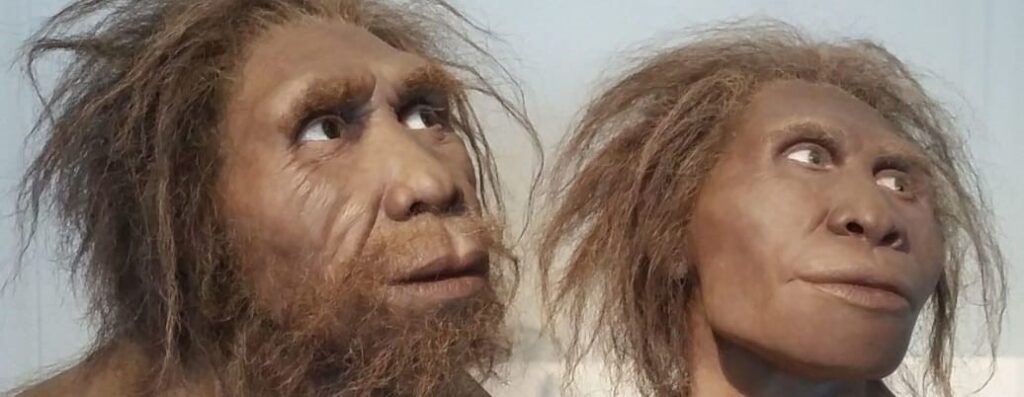
For most of the time our species has existed, we have not been alone. Roughly twenty-one named human species, and almost certainly several more still unknown, have walked this planet. Some were tall and rangy, others short and stocky; some had brains as large as ours, others far smaller. They made tools, controlled fire, buried their dead, and in a few cases almost certainly thought about the world in ways we would recognise as human. Then, one by one, they vanished. For the last forty thousand years or so, Homo sapiens has been the sole survivor. That singular status has encouraged a quiet arrogance: the idea that we represent the inevitable peak of a tidy evolutionary ladder. The fossil and genetic records tell a different story. Humanity’s past was a tangled, bushy tree full of dead ends, side branches, and unexpected connections.
One of the most persistent simplifications is the claim that modern humans evolved directly from Homo erectus. Homo erectus was indeed a remarkable ancestor—long-lived, widely travelled, and the first of our lineage to leave Africa in significant numbers. Yet the path from those early populations to us was neither straight nor simple. African erectus-grade groups gave rise to intermediate forms, often grouped under names such as Homo heidelbergensis or Homo rhodesiensis. From these Middle Pleistocene populations emerged, on one branch, the ancestors of Neanderthals and Denisovans in Eurasia, and on another, the early members of our own species in Africa. The details remain contested—the so-called “muddle in the middle” of the fossil record is still being sorted—but the broad outline is clear. We did not step neatly out of Homo erectus; we inherited a lineage that had already been experimenting with larger brains, more complex tools, and new ways of living for hundreds of thousands of years.
Even more unsettling to tidy categories is the evidence of interbreeding. When Homo sapiens finally left Africa in large numbers, they encountered other human groups that had been evolving separately for half a million years or more. They did not merely coexist; they mated. The children of those unions were fertile. Traces of Neanderthal DNA survive in every non-African population today, typically between one and four per cent. Denisovan ancestry is present in varying amounts, especially among people of East Asian, Southeast Asian, and Oceanian descent. Geneticists have even recovered the genome of a first-generation hybrid whose mother was Neanderthal and whose father was Denisovan. By the strictest reading of the biological species concept—groups that can interbreed and produce fertile offspring—these populations should perhaps be regarded as subspecies or races of a single expansive human species.
Yet most specialists continue to treat them as distinct species. The reasons are not arbitrary. Neanderthals and Denisovans differed from us in skull shape, body proportions, and many subtle anatomical details to a degree that far exceeds the variation seen among living human populations. They had followed separate evolutionary paths for hundreds of millennia, adapting to different climates and landscapes. Gene flow, when it occurred, was limited and episodic rather than continuous. Selection appears to have purged many archaic alleles, particularly those affecting fertility and the X chromosome. In this respect they resemble other pairs of closely related animals—polar bears and brown bears, coyotes and wolves—that can hybridise successfully yet remain recognisable as separate species because of morphology, ecology, and deep divergence. Speciation is a process, not a switch that flips cleanly from “same” to “different.” At the moment our ancestors met the Neanderthals, that process was advanced but still incomplete.
The contrast with modern human “races” is instructive. Living populations differ in skin colour, hair texture, and minor skeletal traits, but the genetic distances among them are small, gene flow has been continuous, and the period of relative isolation has been brief. No living group approaches the morphological or temporal separation that characterised Neanderthals or Denisovans. Calling those archaic populations mere races collapses distinctions that the bones and the genomes both insist upon. At the same time, insisting on rigid species boundaries ignores the fertile hybrids and the DNA we still carry. The truth sits uncomfortably in between.
What emerges from this evidence is not a story of inevitable triumph but one of contingency, contact, and incomplete separation. We are the last human species standing, yet we are also a mosaic. Fragments of other ways of being human persist inside us. The lines we draw—species versus subspecies, ancestor versus cousin, us versus them—are useful for organising knowledge, but they are also human inventions imposed on a past that was far more fluid. Understanding that fluidity does not diminish our uniqueness; it situates it. We are not the sole product of a linear march toward perfection. We are the survivors of a crowded, experimental, and occasionally intimate family history—one that left its mark in our bones, our tools, and the very sequence of our genes. OK
Leave a Reply