
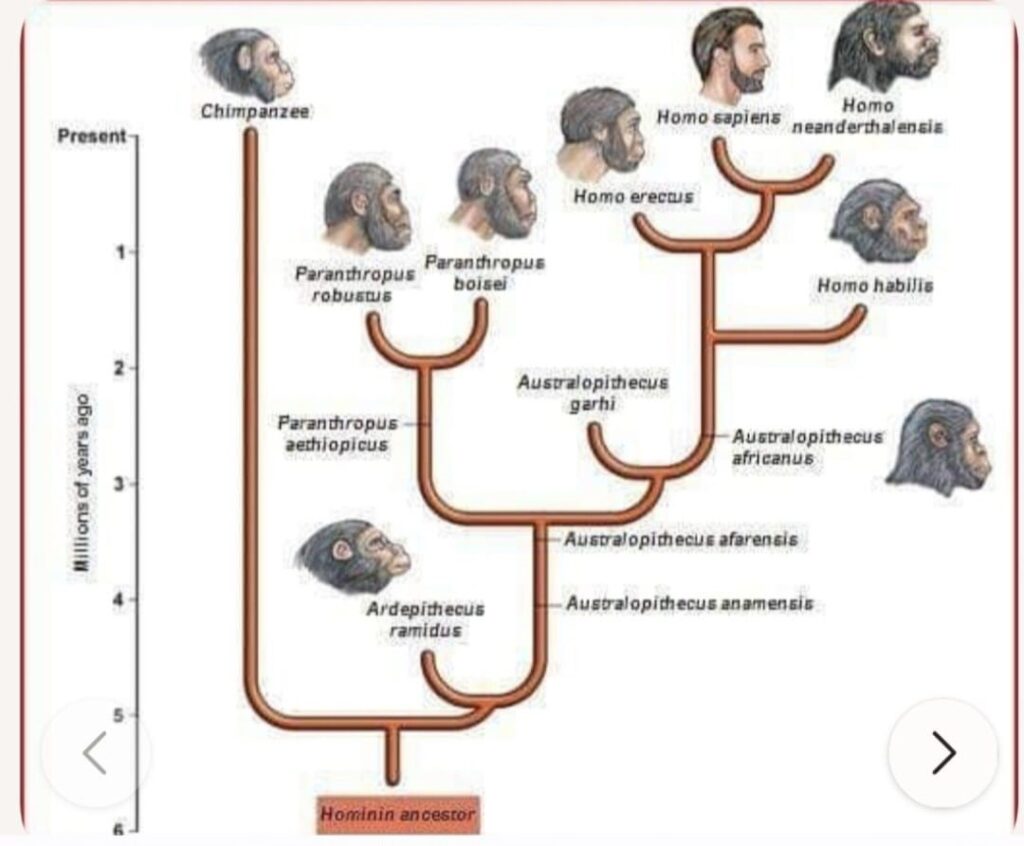
Human evolution is a story of branching paths, survival, and extinction, stretching back millions of years and culminating in the emergence of Homo sapiens as the only surviving human species today. The journey begins with early hominins such as Sahelanthropus tchadensis, who lived around seven million years ago and may have walked upright, and Ardipithecus ramidus, who combined arboreal life with bipedal traits. These species laid the foundation for the australopithecines, including Australopithecus afarensis, famously represented by the fossil “Lucy,” which showed clear evidence of habitual bipedalism. Alongside them, the robust Paranthropus line evolved powerful jaws and teeth adapted for chewing tough vegetation. While successful for over a million years, Paranthropus ultimately became an evolutionary dead end, leaving no descendants.
The genus Homo marked a turning point. Around 2.4 million years ago, Homo habilis appeared, earning the nickname “handy man” for its use of stone tools. Soon after, Homo erectus emerged, lasting from about 1.9 million years ago until as recently as 110,000 years ago. This species was revolutionary: it had modern‑like body proportions, walked fully upright, and was the first to migrate out of Africa, spreading into Asia and Europe. Homo erectus also pioneered the use of fire, a technology that transformed human life. Fire allowed cooking, which made food easier to digest and more palatable, fueling brain growth. It provided warmth, protection from predators, and a social center around which groups could gather. This innovation was arguably the first great leap in human culture.
From Homo erectus descended Homo heidelbergensis, living between 600,000 and 200,000 years ago. In Africa, this species gave rise to Homo sapiens, while in Europe it evolved into Neanderthals, and in Asia into Denisovans. Neanderthals thrived in Ice Age Europe, adapting to cold climates with stocky builds and sophisticated tools. They were skilled hunters and used fire extensively, not only for cooking but also for warmth and survival. Denisovans, known mainly from genetic evidence and a few fossils in Siberia, were close relatives of Neanderthals and likewise relied on fire in their harsh environments. Both species interbred with Homo sapiens, leaving genetic legacies that persist today. Neanderthal DNA contributes to traits such as immunity and skin pigmentation, while Denisovan DNA provides adaptations like high‑altitude tolerance in populations of Tibet and Melanesia.
Despite their success, Neanderthals and Denisovans eventually went extinct, around 40,000 and 50,000 years ago respectively. Homo heidelbergensis had already disappeared earlier, leaving Homo sapiens as the sole surviving branch. Our species emerged in Africa about 300,000 years ago and began migrating out of the continent around 70,000 years ago, long after Homo erectus had already pioneered such journeys. Unlike other hominins, Homo sapiens developed advanced language, symbolic thought, art, and complex social structures. These innovations allowed greater adaptability, cooperation, and cultural transmission, giving us a decisive edge in competition for resources. The ability to form large, interconnected groups and share knowledge across generations enabled rapid technological progress, from sophisticated tools to cave paintings and eventually agriculture.
The survival of Homo sapiens while other hominins vanished was not inevitable. For hundreds of thousands of years, multiple human species coexisted, sometimes in the same regions. Yet our adaptability, innovation, and capacity for symbolic communication set us apart. Interbreeding with Neanderthals and Denisovans enriched our genetic diversity, but ultimately only Homo sapiens endured. Today, we carry within us echoes of those extinct relatives, reminders that human evolution was not a straight line but a branching tree with many experiments in survival. The story of Homo erectus taming fire, of Neanderthals thriving in Ice Age Europe, and of Denisovans adapting to high altitudes all highlight the resilience and ingenuity of our ancestors. Their legacies live on in our DNA, our cultures, and our technologies, making human evolution a tale not just of survival but of transformation. OT
Leave a Reply