
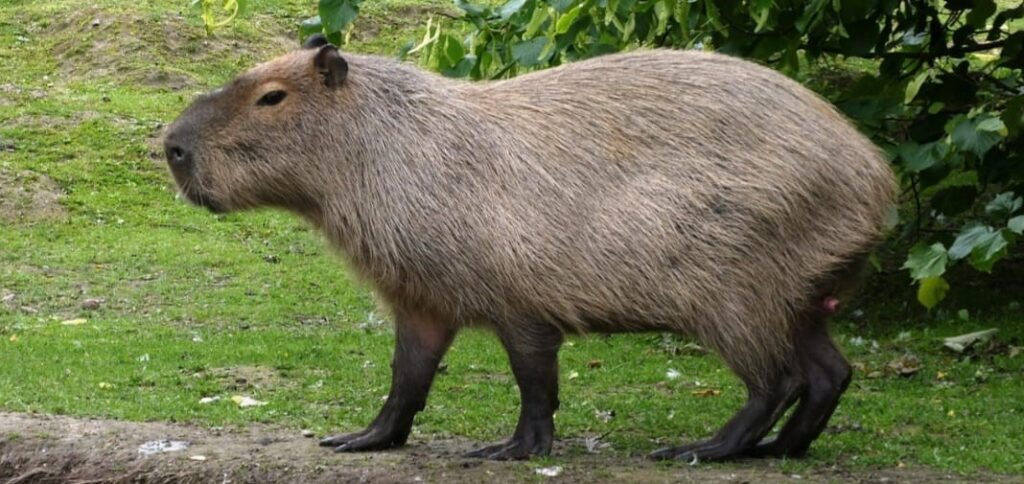
There is something almost absurd about how beloved the capybara has become. It is, after all, a giant rodent — the largest living one on Earth, weighing anywhere from 35 to 66 kilograms in a typical adult, with some exceptional individuals recorded at 79 kilograms or more, and stretching up to 1.3 meters in length. It has a barrel-shaped body, coarse and sparse fur that dries quickly after a swim, a blunt muzzle, small ears, and eyes set high on its head so it can stay alert while mostly submerged in water. Its feet are slightly webbed, its hind legs a touch longer than its forelegs, features that make it a surprisingly fast and capable swimmer despite its ungainly appearance on land. And yet, of all the world’s rodents, it is this one — not the sleek otter, not the clever raccoon — that the internet has crowned the friendliest creature alive.
The reputation is not entirely undeserved, but it is also not quite what it seems. Capybaras are native to South America, ranging from Venezuela and Colombia down through Brazil, Argentina, Uruguay, Paraguay, Bolivia, Ecuador, Peru, and the Guianas, almost always near water — rivers, marshes, and flooded grasslands like Brazil’s Pantanal or Venezuela’s Llanos. In the wild, they live in groups of ten to twenty, sometimes far more, and this deeply social nature is the real foundation of their famous tolerance. Evolution built them to coexist, not to charm. What looks like friendliness to us is, underneath, a nervous system that simply does not panic easily. Capybaras have an unusually low startle response and minimal fear-driven reactivity, and because predatory behavior in animals like big cats is often triggered by fleeing prey, a creature that refuses to flee rarely gets chased in the first place.
This explains the videos that make capybaras internet-famous: a capybara lounging beside a jaguar, sharing space with birds, monkeys, or even alligators. Almost all of these encounters happen in captivity — zoos, sanctuaries, rescues — not in the wild, where a jaguar will hunt a capybara without hesitation, since it is in fact one of the jaguar’s preferred prey. Captive predators are well-fed and often raised alongside these rodents from a young age, removing both the hunger and the habit that would otherwise turn tolerance into predation. The capybara’s calm is real, but the safety it enables is manufactured by human care, not by some special charisma the species holds over predators.
The same complicated truth applies to its relationship with people. Capybaras have been hunted across South America for centuries, prized for meat and hide, and in places like Venezuela there is even a legal, regulated harvest. Yet in areas without hunting pressure, the same low-reactivity temperament that keeps them calm around jaguars keeps them calm around humans too, leading to habituated populations that wander through parks, golf courses, and neighborhoods in Brazil, Argentina, and Uruguay without fear. The viral clips of capybaras soaking in Japanese hot springs or lounging at animal cafes come from exactly these safe, controlled contexts. It is not that capybaras have forged some unusual bond with humanity; it is that their calm shows through wherever we are not actively a threat, and vanishes wherever we are.
Their biology carries other quirks worth knowing. They are hindgut fermenters, meaning the part of their digestive system that ferments fibrous plant matter sits after the point where most nutrients are absorbed — so, like rabbits, they practice autocoprophagy, re-ingesting their own soft, nutrient-rich droppings each morning to recover proteins and vitamins their gut bacteria produced but that would otherwise go to waste. It is an efficient, if unglamorous, evolutionary workaround for surviving on tough vegetation. Males also carry a distinctive scent gland on the snout, called the morrillo, used for territorial marking and a handy way to tell the sexes apart.
Their popularity has carried them well beyond South America. Zoos across North America, Europe, and Australia keep them, often in mixed-species or wetland exhibits, and Japan in particular has turned the capybara into a cultural icon, with hot-spring enclosures where they soak alongside floating yuzu fruit in winter. Curiously, though, capybaras seem far less established in Indian zoos. A search through the National Zoological Park in New Delhi and other major Indian zoological institutions turned up no clear evidence of resident capybaras, though neighboring Sri Lanka has recently brought pairs into its Dehiwala and Pinnawala zoos through an animal exchange program. India’s stricter import and quarantine regulations for exotic species, overseen by the Central Zoo Authority, may partly explain why this particular rodent has not yet found the same foothold there that it has in zoos elsewhere in the world.
What makes the capybara worth writing about is not that it is uniquely gentle or uniquely wise in the ways of interspecies diplomacy. It is that its calm is almost entirely circumstantial — a matter of low cortisol and a herd mentality evolved for surviving among crocodiles and jaguars in open wetlands — and yet that same accident of temperament has made it a genuine ambassador for animal coexistence wherever humans give it the chance. The capybara does not perform friendliness. It simply fails to perform fear, and in a world quick to project meaning onto animals, that absence has been enough to make it beloved. DE
Leave a Reply