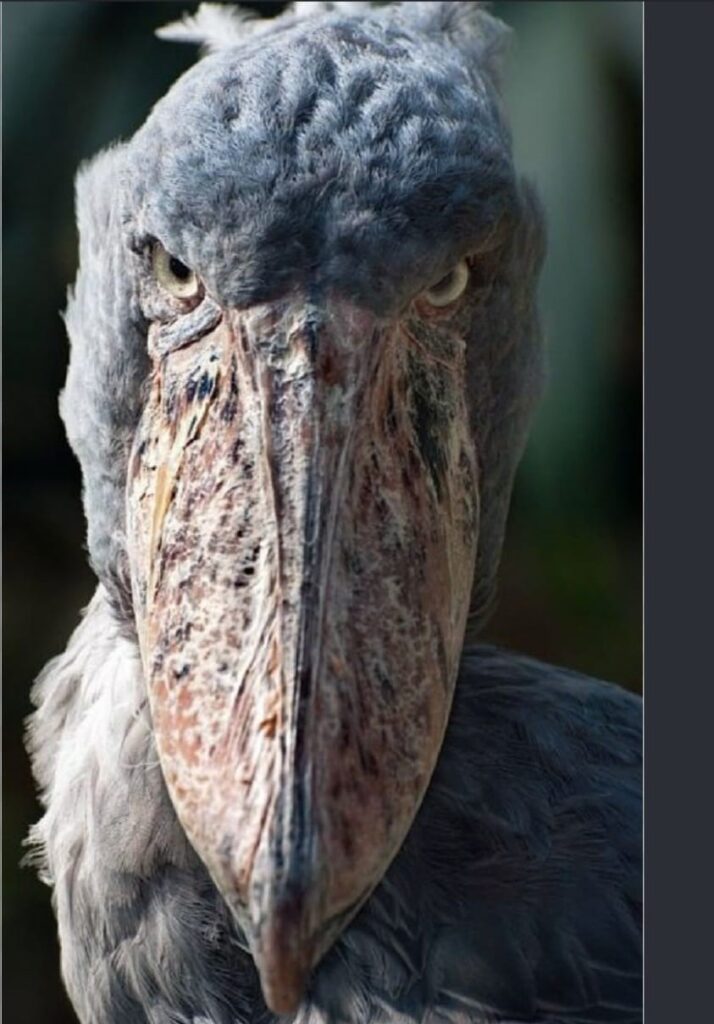
In the papyrus swamps and floodplains of tropical East Africa lives a bird that looks as though it stepped out of deep time. The shoebill, Balaeniceps rex, stands over 1.2 meters tall—sometimes reaching nearly 1.4 meters—with an upright, almost human posture that already sets it apart from other wading birds. Its most arresting feature is the enormous shoe-shaped bill, nearly 24 centimeters long, broad and deep, ending in a sharp hook. Combined with piercing yellow eyes and a gray, prehistoric silhouette, the effect is instantly intimidating. Yet this formidable appearance is largely a matter of optics. Shoebills are solitary creatures that rarely pose any threat to humans. They prefer to keep their distance, and most encounters end with the bird simply standing motionless or slowly moving away.
That stillness is the heart of the shoebill’s character and its survival strategy. For long stretches—sometimes hours—the bird remains completely immobile, body upright, bill angled downward, eyes fixed on water. The sensation of being watched is intense and unsettling; observers often feel the bird is deliberately staring. In reality, this freeze is both a hunting technique and an energy-saving adaptation. By remaining nearly motionless, the shoebill conserves precious energy in a demanding wetland environment while waiting for prey to come within range.
Its diet centers on the creatures that share those oxygen-poor waters: lungfish and catfish that must surface to breathe, along with frogs, water snakes, and even small crocodiles. When a suitable target appears—usually within half a meter to a meter and a half—the transformation is dramatic. The previously statue-like bird launches a sudden, violent forward lunge known as the collapse-and-strike. Specialized neck muscles drive the heavy bill forward with startling speed; the bird throws its full body weight into the motion, often spreading its wings for balance, and may topple or fold forward onto the prey. The entire sequence can take less than a tenth of a second. The reinforced bill, with its sharp cutting edges and hooked tip, engulfs the catch along with water and vegetation. The bird then sways its head side to side to discard debris while keeping a firm grip, sometimes using the bill’s edges to crush or decapitate larger items before swallowing them head-first.
This method is remarkably efficient. Success rates for adult birds often hover around 60 percent, and a single substantial catch can sustain the bird for many hours. The shoebill does not chase; it waits. It does not waste motion; it invests everything in one decisive strike. The same intense focus that makes the bird appear to be staring at human observers is simply the concentrated attention of a patient predator scanning for the subtle surface disturbances of its preferred prey.
There is something almost philosophical in this approach. In a world that prizes constant activity and visible effort, the shoebill demonstrates the power of restraint. Its intimidating form is not a weapon against us but a specialized tool refined over evolutionary time for a narrow ecological niche. Solitary by nature, it forages alone, often maintaining distances of 20 meters or more from other shoebills even in richer habitats. Hippos may unintentionally assist by stirring the water and forcing fish upward, but the bird itself remains a quiet, self-contained presence in the swamp.
To encounter a shoebill is to feel a brief dislocation of time. The upright stance, the massive bill, the unblinking stare—all of it feels older than the modern world. Yet the bird is not a relic. It is a living master of efficiency, a creature that has perfected the art of doing almost nothing until the precise moment when everything must be done at once. In an age of noise and haste, the shoebill offers a quiet reminder: sometimes the most formidable power lies in perfect stillness, and the most effective action begins with the courage to wait.