
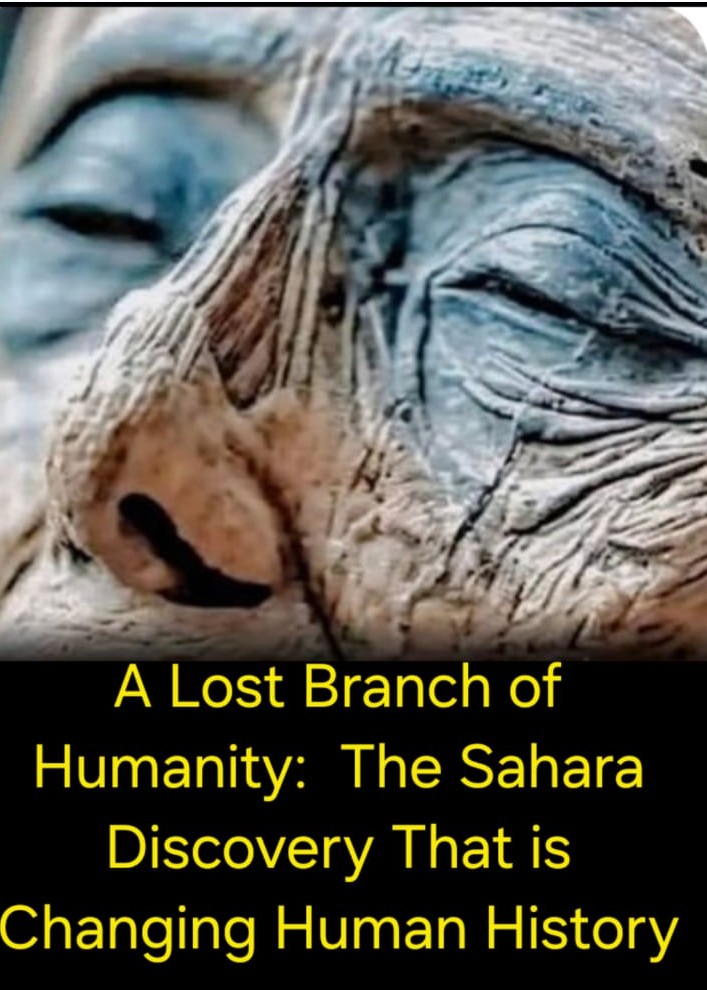
For decades, the story of human history has often been told as one of constant movement. Groups migrated, met one another, exchanged ideas, intermarried, and gradually shaped the genetic tapestry of humanity. While that story is broadly true, remarkable new evidence from two 7,000-year-old mummies discovered in the Sahara Desert reminds us that human history is far more nuanced than a simple tale of endless mixing.
The mummies, found at the Takarkori rock shelter in southwestern Libya, belonged to women who lived during a very different era of African history. At the time, the Sahara was not the vast and unforgiving desert we know today. Instead, it was part of what scientists call the African Humid Period, when the region was dotted with lakes, rivers, grasslands, and thriving human settlements.
Although the remains were first discovered during excavations that began in 2003, it was only recently that researchers successfully extracted and analyzed their DNA. What they found was unexpected. The women belonged to a previously unknown North African genetic lineage that appears to have diverged from sub-Saharan African populations roughly 50,000 years ago and remained remarkably distinct over time.
This discovery challenges a long-standing assumption about the Green Sahara. Archaeologists and geneticists had often envisioned the region as a major corridor through which people moved freely between North Africa and sub-Saharan Africa. A greener Sahara, after all, would seem to encourage migration and interaction. Yet the genetic evidence from Takarkori paints a more complicated picture. The women showed little evidence of substantial genetic admixture with neighboring sub-Saharan African populations or with populations from the Near East and prehistoric Europe.
Perhaps even more surprising is the fact that these individuals practiced animal husbandry. They belonged to a pastoralist society that herded livestock, a cultural innovation generally believed to have originated outside the region. Yet while the practice spread into the Green Sahara, the people themselves appear to have experienced relatively limited genetic mixing.
The implication is profound.
For years, we have often assumed that where technologies and cultural practices travel, people must necessarily move and intermingle on a large scale as well. The Takarkori findings suggest otherwise. Ideas can spread without populations merging. Cultural exchange does not always require genetic exchange.
This distinction matters far beyond ancient Libya. Throughout history, human societies have adopted new technologies, languages, agricultural methods, and belief systems from neighboring groups without losing their own identity. Trade routes have transferred knowledge across continents. Communities have borrowed innovations while remaining genetically distinct. The Takarkori lineage appears to be another example of this phenomenon.
The discovery also serves as a reminder of how incomplete our understanding of human ancestry remains. Genetic studies often uncover branches of humanity that have long since vanished or left only faint traces in modern populations. The people of Takarkori were not a different species, nor were they unrelated to modern humans. They were fully human, living ordinary lives in an extraordinary environment. Yet their DNA reveals a chapter of our shared past that was largely unknown until now.
Ultimately, these ancient women offer a powerful lesson about the human story itself.
Human ancestry was never shaped by a single pattern. Some groups migrated vast distances and mixed extensively. Others remained isolated for thousands of years. Some societies exchanged genes, while others exchanged only ideas. Some lineages flourished and expanded; others faded into history, leaving behind only fragments of their existence buried beneath the sands of time.
The Takarkori mummies remind us that humanity’s past is not a straight line but a complex network of migrations, encounters, separations, adaptations, and survival. Their story underscores the remarkable diversity of the human experience and the many paths our ancestors took in their search for opportunity, resilience, and a better life.
The most important discovery may not be the identification of a previously unknown lineage. It may be the realization that human history is far more intricate than we imagined, and that even in a greener, more hospitable Sahara, people could remain distinct while still participating in a shared cultural world. That complexity is not an exception to human history. It is the essence of it. OT
Leave a Reply