
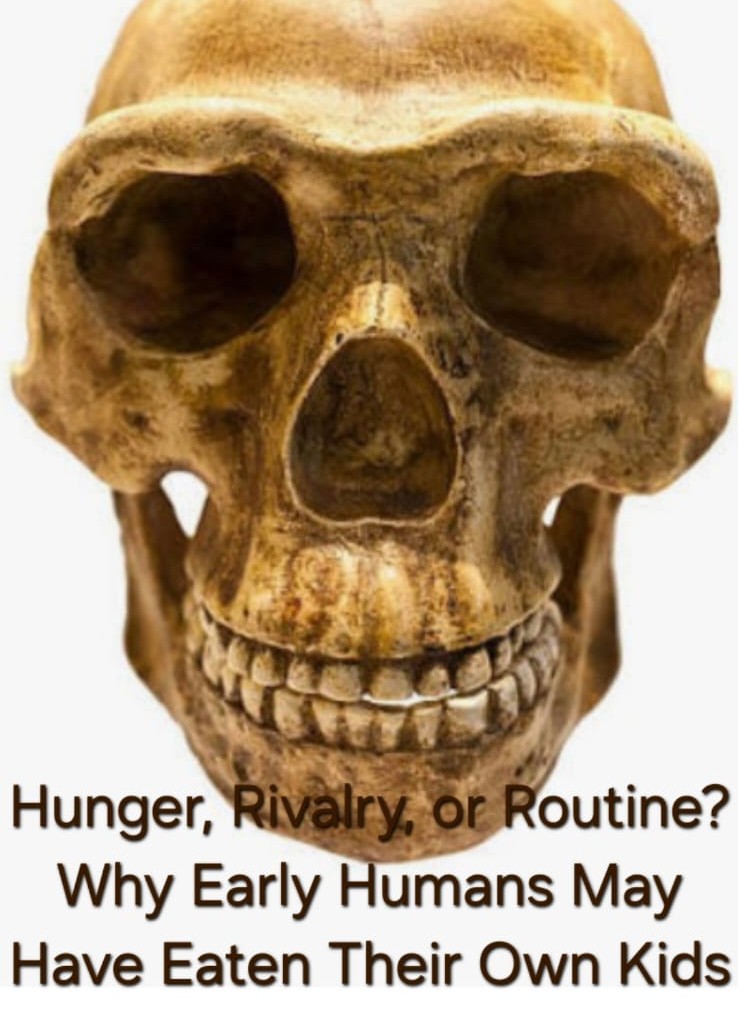
In a cave in northern Spain, archaeologists have uncovered evidence that some of Europe’s earliest known humans ate one another—not once, but repeatedly. The remains of Homo antecessor, found in the Gran Dolina cave at Atapuerca, date to roughly 850,000 years ago. They include the bones of children and adults bearing stone-tool cut marks, fresh-bone fractures made to extract marrow, and patterns of butchery closely resembling those found on animal prey.
The evidence is grim, but it is also scientifically important. It suggests that cannibalism, far from being a rare aberration in the deep human past, may have been woven into the subsistence practices of one of our extinct relatives.
A child’s neck bone
Among the most striking recent discoveries is the cervical vertebra of a child, estimated to have been between two and four years old. The bone bears clear incisions at the anatomical points associated with separating the head from the body. Researchers interpret these marks as consistent with intentional decapitation and processing for consumption.
This was not damage caused by carnivores, sediment pressure, or careless excavation. The cut marks are attributed to stone tools, and they occur where a butcher would need to cut to disarticulate the neck. Together with defleshing marks and fresh-bone fracturing on other remains, the vertebra forms part of a broader pattern of systematic processing.
Not an isolated event
Earlier excavations at the same cave level had already revealed human bones with butchery marks. Paleoanthropologists therefore interpret the cannibalism not as an isolated crisis or ritual, but as a recurrent and habitual practice—part of the subsistence behavior of these early humans.
The evidence spans a long temporal sequence. Researchers have identified a succession of cannibalism episodes at Gran Dolina, involving numerous individuals across a wide age range, from young children to adults. That distribution matters. A single famine, disaster, or ritual killing might leave an unusual deposit; repeated episodes, spread over time and embedded in ordinary butchery practices, point to something more established.
Why early humans may have done it
The hardest question is why. Whether the behavior arose from nutritional stress, territorial competition between rival groups, or was embedded in routine subsistence practices remains debated among paleoanthropologists.journals.
The leading interpretation is nutritional cannibalism: human bodies were treated as a source of meat and marrow, much like deer, horses, bison, or other prey found at the site. But researchers do not generally think this was simply famine-driven desperation. Animal prey remained available, and the recurrence of the practice over a long period makes acute starvation an unlikely sole explanation.
Another influential hypothesis links the violence to intergroup competition. In this view, Homo antecessor groups may have attacked members of rival groups, particularly children and adolescents, weakening competitors while also obtaining food. The two explanations are not mutually exclusive: cannibalism may have been nutritionally useful and tied to conflict.
What seems less likely is ritual. The treatment of the human remains closely parallels the treatment of animal carcasses—cutting, defleshing, and marrow extraction—without clear signs of ceremonial burial or symbolic modification.
Cannibalism in nature
It is also worth resisting the assumption that cannibalism is uniquely human. It is widespread across the animal kingdom, from single-celled organisms to insects, fish, amphibians, reptiles, birds, and mammals.
Praying mantises and some spiders may consume mates; black widow spiderlings may eat their mothers; sand tiger shark embryos consume siblings in the womb; cane toad tadpoles eat eggs and younger tadpoles; and lions, polar bears, chimpanzees, rodents, crocodiles, and Komodo dragons have all been documented engaging in cannibalism under particular ecological or social conditions.
In animals, cannibalism commonly serves clear functions: obtaining nutrition when prey is scarce, eliminating rivals, reducing competition among siblings, or recovering energy from nonviable offspring. That does not make the Atapuerca evidence less disturbing. But it does place it in a wider biological context: cannibalism is not inherently a sign of moral collapse or pathological violence. It can be an extreme but functional response to scarcity, competition, and survival.
What it does—and does not—prove
The Atapuerca evidence should not be used to portray early humans as uniquely savage. Nor should it be romanticized as some timeless “natural” human trait. The remains show that a particular extinct human population, in a particular Pleistocene environment, processed and likely consumed members of its own species on multiple occasions.
That is a narrow but powerful conclusion. It tells us that the capacity for organized violence, carcass processing, and perhaps intergroup conflict has very deep roots in the human lineage. It does not tell us that cannibalism was universal, morally approved, or inevitable.
The most responsible reading is neither sensational nor sentimental. Homo antecessor was not simply “cannibal cavemen” in the tabloid sense. These were early humans navigating a dangerous world with limited technology, uncertain food supplies, and likely competition from other groups. In that world, the boundary between prey and predator may sometimes have been brutally thin.
The child’s vertebra from Gran Dolina is a small bone carrying an enormous implication: nearly a million years ago, some of Europe’s earliest humans did not merely encounter death. In certain circumstances, they may have made a meal of it. TY
Leave a Reply