
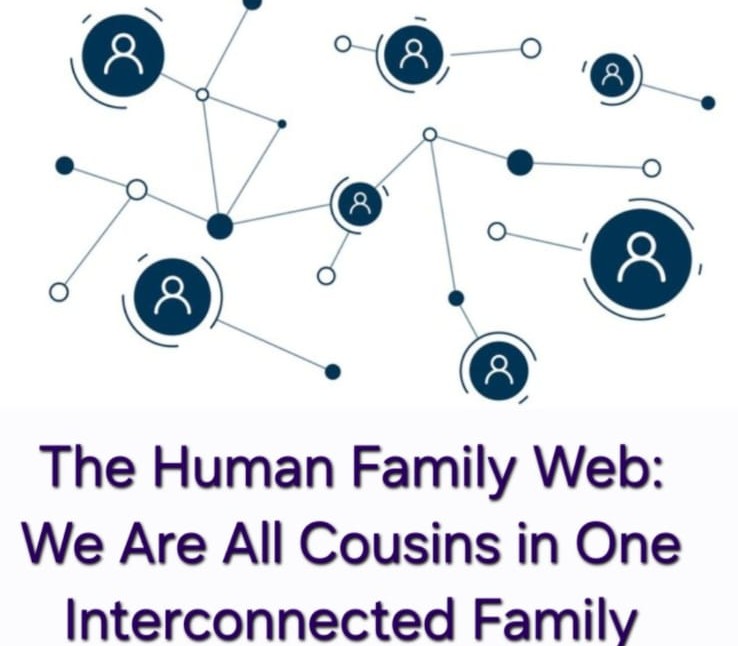
We often speak of people from different countries, races and continents as though they belong to separate branches of humanity. Biology tells a very different story. We are all cousins—perhaps 40th, 50th or even more distant cousins—and the deeper we go into human history, the more tightly our family trees become entangled.
Consider the mathematics of ancestry. Each of us has two parents, four grandparents, eight great-grandparents and, in principle, twice as many ancestors with every preceding generation. Go back 10 generations and there are 1,024 ancestral positions; 20 generations gives more than a million; and 30 generations produces the astonishing figure of 1.07 billion. Thirty generations is only roughly 750 to 1,000 years, depending on the average generation length.
But there is an obvious problem. There were nowhere near a billion human beings alive a thousand years ago. Estimates of the world population around that period are in the hundreds of millions. How, then, can one person have more than a billion ancestors?
The answer is that the human family tree is not really a tree. It is a web.
The mathematical doubling assumes that every ancestral position is occupied by a different person. Real human populations have never worked that way. Relatives married relatives; communities were geographically restricted; populations repeatedly migrated, mixed and reunited. Consequently, the same individual can appear in several different places in our pedigree. This phenomenon is known as pedigree collapse. Your 30-generation ancestry may contain more than a billion ancestral positions, but many of those positions are occupied by the same people.
And the deeper we go into history, the greater the overlap becomes. A person who appears to be a distant stranger may share numerous ancestors with us. Someone living in India and someone living in Europe may have apparently unrelated family histories for many generations, yet their genealogical lines eventually meet. Continue far enough back and the same ancestors can occur in the pedigrees of enormous numbers of people.
This is also why we must distinguish between genealogical ancestry and genetic ancestry. Someone can be our genealogical ancestor without leaving any detectable DNA in us. With each generation, the genetic contribution inherited from a particular ancestor becomes increasingly uncertain. Our family tree therefore contains many more ancestors than the DNA in our bodies can individually reveal.
The extraordinary story of human ancestry becomes even more fascinating when we consider the figures known as mitochondrial Eve and Y-chromosomal Adam. Mitochondrial Eve is the most recent woman from whom all living humans inherited mitochondrial DNA through an uninterrupted maternal line. She probably lived in Africa roughly 100,000 to 200,000 years ago. She was not the first woman, nor the only woman alive at the time.
Y-chromosomal Adam is the corresponding paternal-line ancestor of living men: the man from whom their Y chromosomes ultimately descend through an unbroken father-to-son lineage. A 2013 study led by Paolo Francalacci produced an estimate of roughly 180,000–200,000 years ago, although estimates have varied as genetic data and methods have improved. He too was not the only man alive then.
Neither mitochondrial Eve nor Y-chromosomal Adam should be imagined as the original parents of humanity. They are simply the surviving endpoints of particular genetic lines. Other women’s mitochondrial lines and other men’s Y-chromosome lines eventually disappeared.
The most astonishing possibility concerns the autosomal most recent common ancestor—the individual who, according to population-genetic and genealogical modelling, may have been an ancestor of every living human. Under some models, this common genealogical ancestor could have lived only a few thousand years ago, with estimates around 1,500 BC.
That sounds impossible until we understand the web.
Once populations repeatedly mix, migrate and intermarry, ancestry spreads extraordinarily quickly. A person who lived several thousand years ago could, in principle, become an ancestor of people across huge portions of the world. Meanwhile, many other people from the same period may have left no descendants alive today.
This does not mean that humanity has a single recent biological ancestor in the simplistic sense. Nor does it erase the enormous genetic and cultural diversity that developed among human populations. It means something subtler and perhaps more profound: our genealogical histories are far more interconnected than our modern identities suggest.
Human history is therefore not a collection of isolated family trees. It is a gigantic network of branches that repeatedly separate, cross, reconnect and merge.
The stranger standing across the street may be our 40th cousin. Someone on another continent may be our 50th cousin. And if we travel sufficiently far back in time, the distinction between “my ancestors” and “their ancestors” begins to disappear.
We are not merely members of the same species. We are members of the same enormous, tangled family.
The human family tree is a web—and every one of us is caught in it. PT
Leave a Reply