
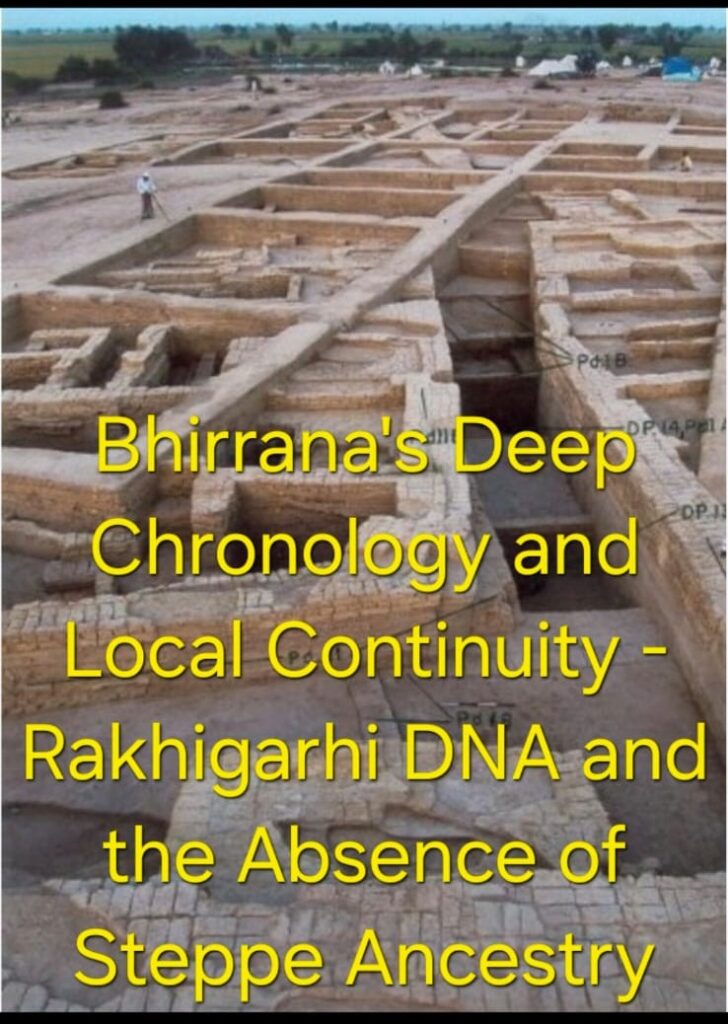
For decades, the story of the Indus Valley Civilization has been framed through a particular lens: a sophisticated Bronze Age culture that emerged in the northwest of the subcontinent, reached its urban peak between roughly 2600 and 1900 BCE, and then transformed amid environmental change and population movements. Sites such as Harappa and Mohenjo-daro stood as the classic markers of that peak. Newer evidence from Bhirrana and Rakhigarhi in Haryana complicates and deepens that picture. It points to a longer local trajectory of settlement and, at the height of the mature phase, a population without the Steppe (or Aryan) ancestry that later became part of the South Asian genetic landscape.
Bhirrana, a modest mound along the Ghaggar-Hakra system in Fatehabad district, has produced one of the more ambitious chronological claims in Indian archaeology. Excavations directed by L.S. Rao between 2003 and 2006 revealed a sequence beginning with Hakra Ware levels marked by subterranean dwelling pits, followed by Early Harappan mud-brick architecture, early mature fortification, and finally classic Mature Harappan urban features including streets, drains, seals, and craft production. Radiocarbon dates from the lowest levels include charcoal samples that, when calibrated, fall in the range of approximately 7570–6200 BCE. These figures have been used to place the onset of occupation in the eighth–seventh millennium BCE, several millennia earlier than the conventional start of the Mature Harappan phase at Harappa itself (around 2600 BCE) and even earlier than the site’s own earliest recognized levels (late fourth millennium BCE).
If the earliest dates hold, Bhirrana was already a settled community when the classic cities of the Indus system were still centuries or millennia in the future. The claim is not uncontested. Other charcoal samples from early levels date to the more familiar 3200–2600 BCE window, Hakra Ware elsewhere in the region is generally assigned to the fourth millennium BCE, and the presence of smelted copper sits uneasily with a pure Neolithic horizon of the eighth millennium. Specialists such as Gregory Possehl expressed reservations about drawing sweeping conclusions from a limited set of early radiocarbon results. Still, the continuous cultural sequence at Bhirrana—from pit dwellings to planned settlement—supports the idea of gradual, local development rather than an abrupt external imposition of urbanism.
Rakhigarhi, the largest known Indus site and also in Haryana, supplies complementary evidence of a different kind. In 2019, researchers published the first genome-wide data from a Mature Harappan individual buried there (roughly 2800–2300 BCE). The ancestry profile was a mixture of Iranian-related ancestry—from a lineage that had diverged before the spread of farming on the Iranian plateau—and ancestry related to ancient Southeast Asian or Ancestral South Indian hunter-gatherers. Critically, there was no detectable Steppe pastoralist ancestry. This genetic signature matches the “Indus Periphery” cluster identified in contemporaneous outliers from sites in cultural contact with the Indus region. A companion study of ancient DNA across Central and South Asia showed that Steppe-related ancestry, associated with Bronze Age pastoralists of the Eurasian steppes and widely linked to the later spread of Indo-European languages, only becomes visible in South Asia after about 1500 BCE—after the mature urban system had already begun to transform.
Taken together, the archaeological sequence at Bhirrana and the genetic data from Rakhigarhi strengthen the view that the mature Indus Civilization was built by populations already established in the region. The civilization’s urban peak was achieved without the Steppe component that appears in many later North Indian groups. In that precise sense the people of the mature phase were “pre-Steppe.” Farming and settled life appear to have involved local adoption or development rather than a large-scale influx of western Iranian farmers during the relevant period. Cultural continuity from early village levels to planned towns is visible on the ground at sites such as Bhirrana.
None of this requires a simplistic narrative of pure isolation. The Iranian-related ancestry itself reflects earlier population movements into the northwest. Human history in the subcontinent is a long record of migration, admixture, and cultural exchange. Nor does the absence of Steppe ancestry at Rakhigarhi around 2500 BCE disprove later gene flow; the genetic evidence for that later admixture is robust. What it does challenge is any model that places Steppe-derived populations at the heart of the mature Indus cities or treats the civilization as a secondary product of external urbanizing forces.
The implications are both scholarly and cultural. Chronologies that begin the Indus story only with the mid-third-millennium cities miss the deeper regional roots that sites like Bhirrana appear to document. Genetic data that show a mature Indus population without Steppe ancestry clarify the timing of later demographic changes. The result is a more layered history: an indigenous trajectory of settlement and urbanization in the Ghaggar-Hakra and Indus plains, followed by subsequent admixture that reshaped the ancestry of many South Asian populations after the urban peak had passed. That history is still being written, one excavation trench and one ancient genome at a time. OK
Leave a Reply