
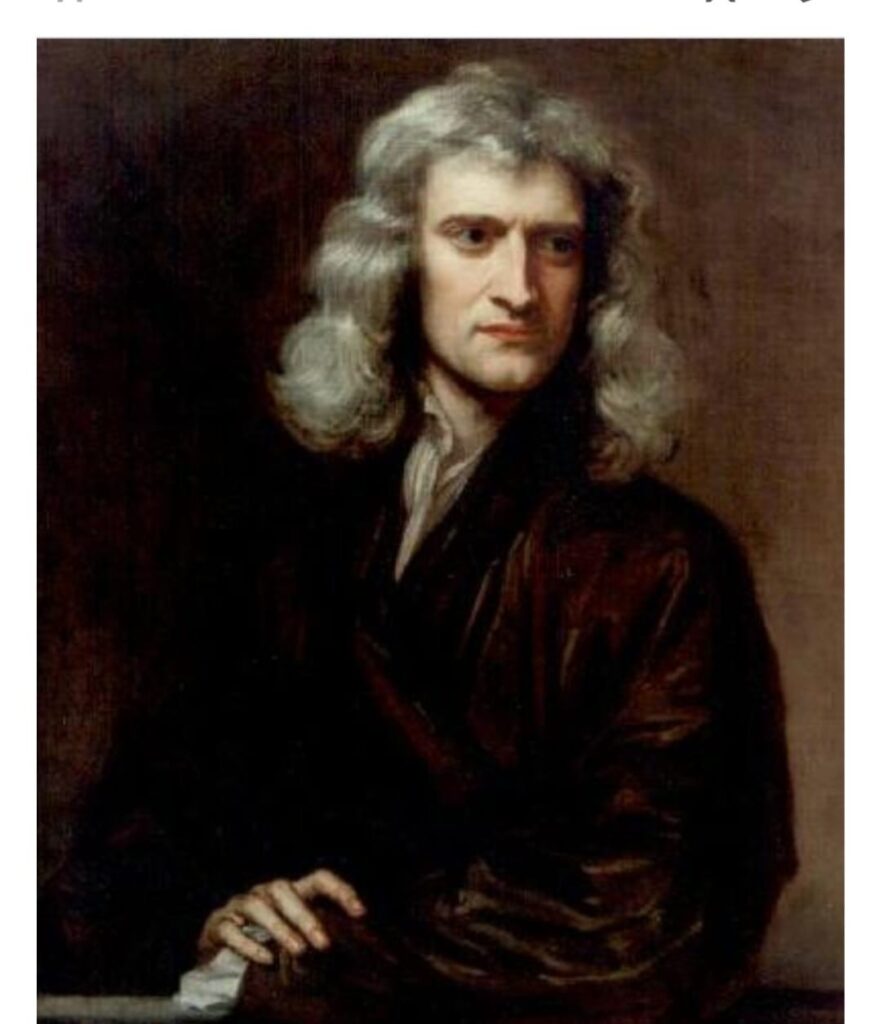
Isaac Newton and Elon Musk could hardly appear more different. Newton was the seventeenth-century mathematician who gave humanity the laws of motion and universal gravitation. Musk is the twenty-first-century entrepreneur betting on electric cars, artificial intelligence, humanoid robots and space travel. Yet, separated by nearly four centuries, both have imagined a profound transformation of human civilization—and both have attached that transformation to a future in which the existing order gives way to something radically different.
Newton’s famous “2060 prophecy” is often presented as an apocalypse. That is not quite what he meant. Newton was deeply engaged in biblical prophecy, particularly the Book of Daniel and the Apocalypse. He believed that prophetic periods described in “days” could represent years. Taking AD 800 as the beginning of a 1,260-year period, he arrived at 2060. But he explicitly cautioned against treating the date as an exact prediction. His calculation was a private theological exercise, not a scientific forecast that Earth would be destroyed in 2060.
More importantly, Newton did not envision 2060 simply as the end. His interpretation contained an extraordinary element of renewal. The collapse of the old religious order would, in his understanding, be followed by the establishment of a new divine order—a thousand-year Kingdom of God. In Newton’s imagination, therefore, catastrophe was not the destination. It was the threshold of transformation.
Now consider Elon Musk.
Musk’s vision has no biblical prophecy, no Book of Revelation and no divine timetable. His prophet is technology. Artificial intelligence, he argues, will become enormously capable, while humanoid robots will perform an ever-growing share of physical labour. The result, he believes, could be an “age of abundance” in which the production of goods and services vastly exceeds today’s capacity. In 2026, Musk went beyond the familiar idea of universal basic income and spoke instead of “universal high income.”
The distinction is revealing. Universal basic income assumes that people may need a modest financial floor because technology has displaced their jobs. Musk’s universal high income imagines something much more radical: technology could make abundance so great that people would no longer be constrained by today’s relationship between employment, income and consumption.
He has even suggested that money itself might eventually become irrelevant. If intelligent machines and robots can produce virtually everything humans require, the traditional economic problem of scarcity begins to disappear.
Newton and Musk therefore offer two versions of the same extraordinary human fantasy: the belief that history has a threshold beyond which ordinary human life will no longer be ordinary.
For Newton, the transformation was spiritual. For Musk, it is technological. Newton saw prophecy as the mechanism; Musk sees artificial intelligence and robotics. Newton imagined a divine kingdom after the breakdown of an old order. Musk imagines an abundant society after machines break the link between human labour and material production.
But there is a deeper similarity. Both visions confront the same question: What happens to human beings when the system that has structured their lives disappears?
For Newton, the old political and religious order would give way to something fundamentally new. For Musk, the old economic order—where people work because they need income to obtain scarce goods—could become obsolete.
And this is where Musk’s utopia becomes more complicated than it first appears. Abundance does not automatically produce happiness. If machines perform the work that gives people their income, status and daily structure, humanity will have to answer a question that economics has largely postponed: What is human life for when survival no longer requires work?
Musk himself has acknowledged the problem of purpose. Other technology leaders have similarly imagined a future in which conventional employment becomes less central, while warning that distributing the enormous wealth created by AI and robotics will be a major social and political challenge.
There is also a crucial difference between Newton’s and Musk’s visions. Newton’s prophecy was an interpretation of an existing sacred text. Musk’s prediction depends on technologies that have not yet achieved the capabilities he anticipates. Today’s AI revolution is real, but the economic transformation remains uncertain. Massive investment is pouring into AI infrastructure, while economists continue to debate how quickly productivity gains will materialise and whether today’s expectations have outrun the evidence.
That uncertainty, however, does not make the comparison less fascinating. It makes it more so.
Newton looked into the future and saw the end of one historical order and the emergence of another. Musk looks into the future and sees machines so productive that the economic foundations of the present could dissolve.
One calculated with biblical numbers. The other calculates with computing power, robotics and productivity.
Newton’s 2060 was not really about the end of the world. Musk’s age of abundance is not really about robots. Both are ultimately about the same question: can humanity cross a threshold beyond which the rules governing human civilization are fundamentally changed?
Perhaps that is why the two visions resonate across four centuries. Humans have always imagined a better world beyond the limitations of the present—sometimes through God, sometimes through science, sometimes through technology.
Newton called it the coming Kingdom.
Musk calls it the age of abundance.
The vocabulary has changed. The human longing for transformation has not. PT
Leave a Reply