
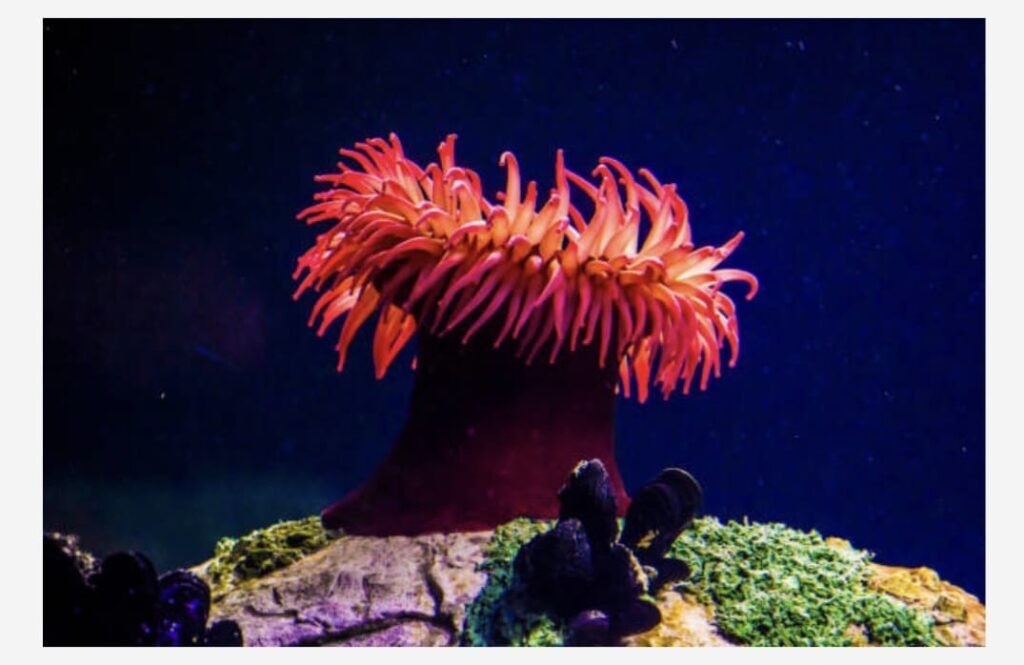
The search for humanity’s origins often leads us to fossils of ancient mammals, dinosaurs, or early human ancestors. Rarely do we imagine that one of the most important clues to our own biological history might be hidden inside a soft-bodied sea creature anchored to a rock on the ocean floor. Yet that is precisely what a recent scientific discovery suggests.
Researchers have found that sea anemones use a developmental mechanism known as BMP-Chordin shuttling, a process that helps organize the body during embryonic development. On the surface, this may sound like a technical detail of biology. In reality, it has profound implications for our understanding of evolution and the origins of animal life.
Sea anemones belong to a group called cnidarians, which also includes corals and jellyfish. They possess no brain and lack the complexity that we normally associate with advanced animals. Nevertheless, researchers have discovered that these seemingly simple creatures use the same molecular toolkit employed by animals as diverse as frogs, flies, worms, and humans to establish fundamental body structures. This finding suggests that one of the key mechanisms responsible for shaping animal bodies is far older than previously believed.
At the heart of the discovery are Bone Morphogenetic Proteins, or BMPs. These proteins act as signalling molecules during embryonic development. They help cells determine where they are located within a developing organism and what they are destined to become. Depending on the signals received, cells may develop into nervous tissue, skin, organs, or other specialized structures. In effect, BMPs provide embryos with a positional map.
However, BMPs do not work alone. A molecule called Chordin regulates their activity. By binding to BMPs and transporting them through a process known as shuttling, Chordin helps establish the concentration gradients that guide tissue formation and define body axes. Together, BMPs and Chordin function as a biological navigation system, ensuring that cells develop in the correct place and at the correct time.
What makes the new finding remarkable is that the BMP-Chordin system was already known from animals with bilateral symmetry, creatures possessing a clear left and right side, a front and back, and a top and bottom. Humans, insects, fish, birds, and countless other animals belong to this category. Sea anemones, by contrast, have long been regarded as members of a more ancient and simpler branch of life.
The discovery that sea anemones use essentially the same developmental machinery narrows the apparent gulf between cnidarians and bilaterians. It suggests that the common ancestor of these groups, which lived more than 600 million years ago, may already have possessed the molecular tools required to organize a complex body plan.
The timeline is astonishing. Life itself emerged on Earth roughly 3.8 billion years ago. For most of that immense span of time, the planet was inhabited only by microscopic organisms. Complex multicellular animals appeared relatively late. The ancestor implied by the BMP-Chordin discovery lived long before the Ordovician Period and even before the celebrated Cambrian Explosion, when animal diversity expanded dramatically.
In other words, long before trilobites crawled across ancient seafloors and hundreds of millions of years before the first dinosaurs or mammals appeared, evolution may already have developed a sophisticated genetic mechanism for organizing animal bodies.
This realization challenges a common misconception about evolution. We often imagine progress occurring through the continual invention of entirely new biological systems. Increasingly, however, science reveals that evolution is also a story of conservation. Ancient genetic tools are retained, modified, and repurposed across vast stretches of time. The same developmental instructions that help shape a sea anemone today may be related to those that guide the formation of the human nervous system and body axis.
There is also a philosophical dimension to this discovery. Humanity has traditionally viewed itself as separate from simpler forms of life. Yet the deeper scientists probe into genetics and development, the more evident our connections become. A creature without a brain, living quietly beneath ocean waters, may preserve evidence of biological instructions shared with us across more than 600 million years of evolutionary history.
The sea anemone’s message is both humbling and inspiring. It reminds us that the roots of our existence run deeper than civilizations, continents, or even vertebrates. They extend into a distant world where the earliest animals were experimenting with the molecular blueprints that would eventually give rise to coral reefs, insects, whales, and human beings. In that sense, the discovery is not merely about sea anemones. It is about understanding how, from a common ancestral toolkit, evolution built the astonishing diversity of life that inhabits Earth today. OT
Leave a Reply