There are few everyday customs that carry as much history in them as a cup of tea. In Britain, tea became far more than a beverage: it became a ritual, a marker of class, an expression of hospitality and eventually an institution. But the story of Afternoon Tea and High Tea is particularly fascinating because the two customs, often confused today, travelled through different social worlds before finding an unexpected second life in South Asia.
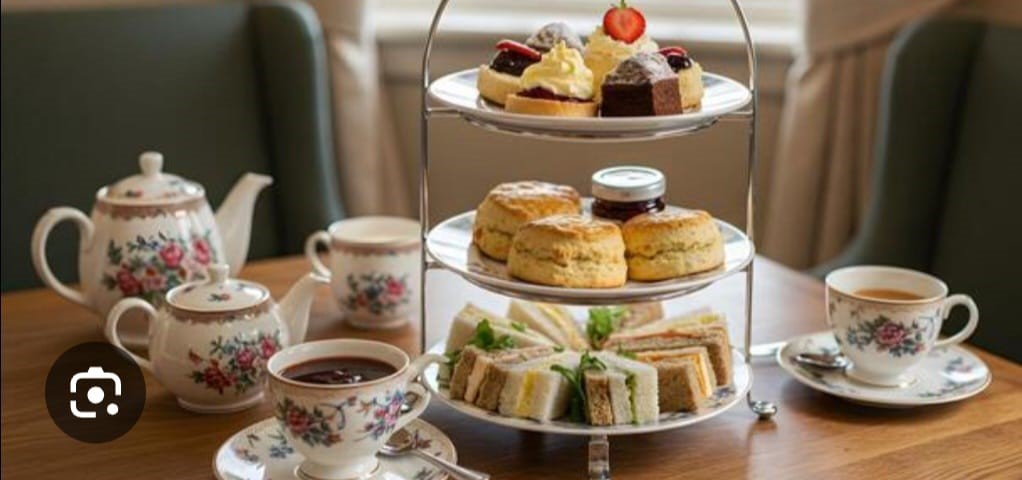
The origins of Afternoon Tea are generally traced to Anna, Duchess of Bedford, in the 1840s. In Victorian England, fashionable households commonly had breakfast and a late dinner, leaving a long gap between the two. The Duchess reportedly began asking for tea, bread, butter and cakes in the afternoon to overcome what she described as a “sinking feeling.” What began as a personal response to hunger gradually became a fashionable social occasion. Friends were invited, tea was served with delicate sandwiches, scones, cakes and pastries, and an entirely new ritual of polite society emerged.
Afternoon Tea acquired its glamour from the aristocracy and, eventually, from the royal world. It became associated with fine china, silverware, elegant dresses, impeccable manners and carefully arranged food. During the Victorian era, tea drinking and Afternoon Tea became powerful symbols of British refinement. The custom was not invented by the monarchy, but royal and aristocratic patronage helped give it an aura that survives to this day.
The terminology surrounding tea, however, can be confusing. What we now call Afternoon Tea was later sometimes described as “Low Tea”, largely because it was served around a low table. It was a light social meal, usually taken in the middle or late afternoon. The word “low” referred not to its social status but to the height of the table.
High Tea was something quite different in its original British meaning. It was traditionally served later in the day at a normal or high dining table and was a considerably more substantial meal. It was historically associated more with working- and middle-class households and could include bread, meat, potatoes and other savoury foods. Thus, contrary to popular modern usage, High Tea was not originally an aristocratic version of Afternoon Tea.
Yet history rarely leaves customs untouched. When British institutions, including the military, established themselves in India, tea and mess traditions travelled with them. After independence and Partition, many of these customs survived in the armed forces of India and Pakistan, and later in Bangladesh as well. But they did not remain frozen in their British form. South Asia absorbed the tradition and made it its own.
The military High Tea that became familiar in the region could be a considerably more substantial affair than the delicate British Afternoon Tea. Tea might be accompanied by sandwiches, cutlets, samosas, pakoras, savouries, cakes, biscuits and sweetmeats. In such circumstances, High Tea could function almost as an early-evening meal. Indeed, after a proper High Tea, dinner might seem entirely unnecessary.
This is where the South Asian military tradition becomes particularly interesting. In the officers’ mess, High Tea was not merely an opportunity to drink tea. It was part of a culture of hospitality and camaraderie. Officers, families and guests could meet informally while still observing the traditions of military courtesy and orderly social interaction. The British framework remained visible, but the food and atmosphere became distinctly South Asian.
India, Pakistan and Bangladesh therefore share more than a political and historical past. Their military tea traditions also reflect a common institutional inheritance from the British Indian Army. The three countries subsequently developed their own national identities, but the mess culture survived—and so did the High Tea.
There is an amusing historical circle here. Tea travelled from East Asia to Britain, where it became embedded in aristocratic culture and acquired elaborate rituals. The British then carried those rituals back to South Asia, where they were absorbed, modified and transformed. Afternoon Tea remained the elegant British tradition; High Tea acquired a new South Asian personality.
And perhaps that is why tea has survived so magnificently. It is remarkably adaptable. It can be a Duchess’s afternoon indulgence, a Victorian social ritual, a British working family’s evening meal, or a lavish military gathering in an Indian, Pakistani or Bangladeshi mess.
The cup remains the same. The history poured into it is not. PT
Leave a Reply