
For millions of years, human evolution unfolded in Africa under hot, shifting climates, and that matters because our bodies were shaped in environments where shedding heat was often more important than conserving it. Early hominins probably did not look like modern humans at all in this respect. They likely began with a more ape-like coat of body hair and then, over a long stretch of evolution, lost much of it. The change was not a sudden disappearance of fur, and it was probably not caused by clothing. Rather, it seems to have been driven by natural selection for better thermoregulation, endurance activity, and possibly parasite control. Humans did not become hairless because they started wearing hides; they began losing fur first, and clothing came later as a response to that biological shift.
What did early hominins actually lose? Not every hair, and not all at once. Modern humans still carry millions of fine vellus hairs, and we retain thicker hair in certain regions such as the scalp. So the evolutionary change was not a move from “fully furry” to “fully naked,” but from a dense insulating coat to a much sparser covering. The torso and limbs likely lost the most visible fur, while the scalp retained hair because the head is exposed to direct solar radiation. This left humans with skin that could cool more efficiently through sweating, but also made us far more vulnerable to cold, sunburn, and abrasion. In practical terms, we traded insulation for heat loss.
That trade-off was crucial. A fur coat is excellent for conserving heat, but not ideal for a large-bodied, highly active animal in hot conditions. As humans became more dependent on sustained walking, running, and daytime activity, a sweat-based cooling system became more advantageous. Sparse body hair allowed sweat to evaporate more effectively, helping early humans avoid overheating. At the same time, scalp hair likely served as a kind of protective parasol, reducing solar heat gain while still allowing heat to escape. So the body as a whole moved toward a design that favored cooling over warmth, even though the head retained a specialized exception.
Once this happened, new problems emerged. Hairlessness made early humans more exposed to environmental stress, especially in colder climates, where fur would have helped tremendously. That is where clothing entered the story. The earliest archaeological evidence for clothing is indirect, because skins and fibers rarely preserve, but hide-processing tools dated to around 120,000 to 90,000 years ago in Morocco strongly suggest that people were working animal skins in ways consistent with garment production. Lice genetics add a different kind of evidence: body lice could only evolve once clothing created a stable niche for them, and those genetic studies suggest clothing use may have begun far earlier than once thought, possibly around 170,000 years ago or even earlier, though the exact date is debated. Together, these lines of evidence imply that clothing was not the cause of hair loss; it was one of the adaptations that helped humans live with the consequences of it.
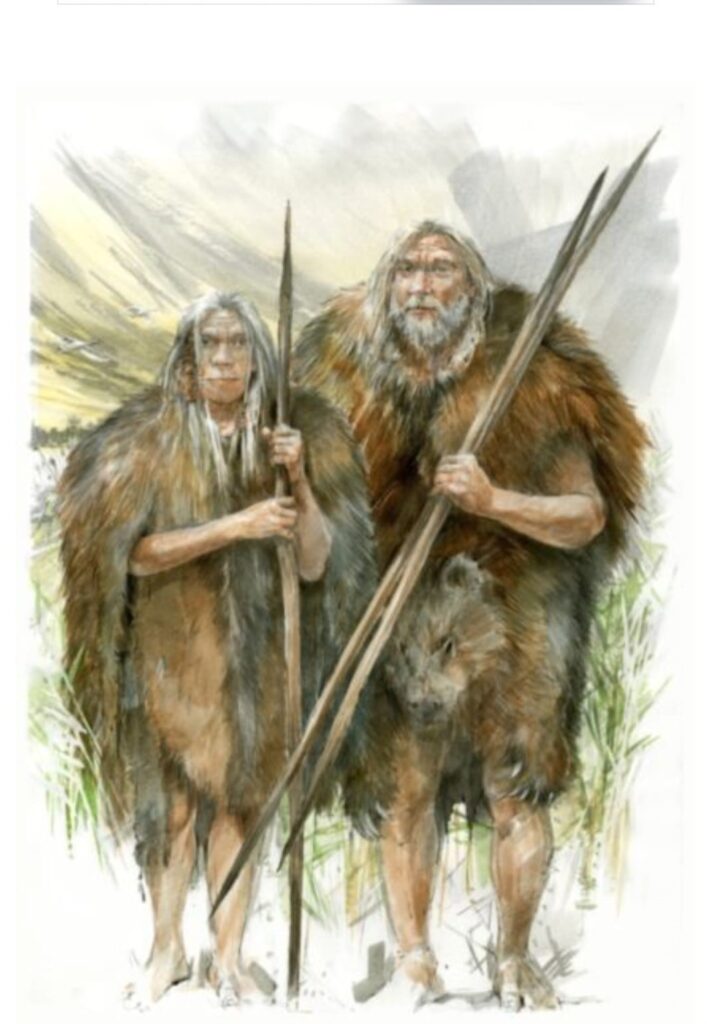
This also helps explain the role of Neanderthals and later Homo sapiens. Neanderthals almost certainly wore clothing too, especially in colder regions, but their dress was probably simpler and more reliant on animal skins, wraps, and capes. Homo sapiens seem to have developed a broader toolkit, including sewing technologies and eyed needles that made fitted garments more likely. The difference was not that one species dressed and the other did not. It was more a matter of complexity, flexibility, and how well clothing could be tailored to harsh climates. Clothing became a cultural solution to a biological problem.
Behind all of this was not just anatomy, but social structure. Innovation in the Paleolithic world depended on whether useful ideas could spread through communities. Small, isolated groups could invent useful techniques, but those techniques were easy to lose. Larger and more connected social networks allowed knowledge to circulate, survive, and accumulate. That meant clothing, like other technologies, improved when people were embedded in wider webs of exchange. A hide-working trick, a sewing method, or a better way to layer skins mattered only if others could learn it and pass it on. Human innovation was therefore not simply a product of intelligence, but of social connectivity.
So the larger story is this: humans evolved in Africa as heat-adapted mammals with less fur, not because they first wore clothes, but because evolution favored a body that could dump heat efficiently. Hair loss changed thermoregulation, making us better suited to hot, active life but more exposed in the cold. Clothing then emerged much later as a cultural answer to that new vulnerability, while social networks helped such innovations spread and survive. In the end, the history of clothing is also the history of how a hairless ape learned to solve biological limits through culture. TY
Leave a Reply