
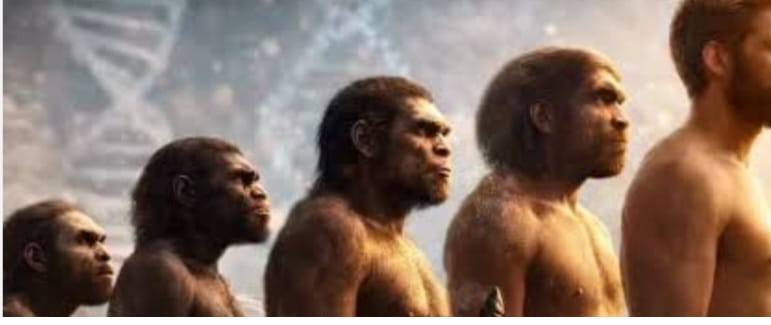
Imagine a world where your neighbours were not just people of different cultures, but people of entirely different species. For most of our existence as a genus, that was precisely the reality. Earth was home to a bustling, diverse family of human-like beings, each with their own faces, bodies, and survival strategies. And then, one by one, they all vanished, leaving only us. The question of why remains the greatest unsolved mystery of our origins.
The human family tree is not a straight line leading triumphantly to modern Homo sapiens. It is a bushy, tangled thicket of experimental branches, most of which went extinct. At least twenty-one different species of early humans once roamed the planet, and for vast stretches of prehistory, several of them lived at the same time, in the same places. We have direct, almost haunting evidence of this coexistence. In Kenya, along the shores of Lake Turkana, scientists discovered 1.5-million-year-old footprints preserved in mud. Two distinct species—Homo erectus, a tall, long-legged ancestor, and Paranthropus boisei, a small-brained, large-toothed vegetarian—had walked across that same muddy ground within hours or days of each other. They shared a landscape, perhaps even glanced at one another across the savanna. From about 300,000 to 50,000 years ago, Neanderthals, Denisovans, and early Homo sapiens all coexisted across Eurasia. Our own ancestors were not alone; they were part of a crowded, competitive world.
These ancient relatives were remarkably diverse. Homo habilis, the “handy man” of East Africa, stood barely four feet tall with long, ape-like arms, yet he was the first to chip stone into cutting tools. In the same region, Paranthropus boisei had massive jaws and a bony crest atop his skull for chewing tough plants—a living food processor. Then came Homo erectus, the great explorer, who grew to nearly six feet, developed long legs for endurance running, and became the first hominin to leave Africa, spreading all the way to Southeast Asia. In Europe, Homo heidelbergensis built wooden shelters and hunted elephants with wooden spears, while his descendants, the Neanderthals, evolved stocky, barrel-chested bodies perfectly adapted for Ice Age cold. Meanwhile, in Siberia and the Tibetan Plateau, the mysterious Denisovans thrived at high altitudes, passing down a gene for oxygen efficiency that still protects modern Tibetans today. On the remote island of Flores in Indonesia, Homo floresiensis—the “Hobbit”—stood just three and a half feet tall, having evolved island dwarfism, yet somehow hunted dwarf elephants. Each of these species was a unique solution to the problem of survival, tailored to a specific time and place.
What happened when all these different humans met? They competed, they fought, and they also fell in love. When early Homo sapiens migrated out of Africa around 60,000 years ago, they walked straight into Neanderthal territory in Europe and the Middle East. For thousands of years, they shared the same caves, hunted the same mammoths, and occasionally clashed. But they also mated. If you have European or Asian ancestry, about 1.5 to 2.5 percent of your genome is Neanderthal—a living inheritance from those ancient encounters. In fact, interbreeding happened on at least three separate occasions. The same is true for Denisovans: modern Papuans, Aboriginal Australians, and Filipinos carry up to five percent Denisovan DNA, including that high-altitude gene. Even in Africa, our ancestors mated with unknown “ghost” hominins whose fossils we haven’t even found. These hybrids were not sterile or disadvantaged. Many of those inherited genes boosted immune systems, improved fat metabolism, and helped our ancestors adapt to new environments. We are not pure Homo sapiens; we are walking mosaics, hybrid descendants of several lost lineages. The other species were not simply wiped out—they were, in many ways, absorbed into us.
Despite this intermingling, all those other human species eventually disappeared, leaving us alone. The final chapter belongs to the Neanderthals, who made their last stand in southern Iberia around 39,000 years ago. The period between 50,000 and 30,000 years ago was a crucible. Climate change was relentless, with wild swings between freezing glacial periods and warmer spells that Neanderthals, as cold-weather specialists, struggled to endure. A massive volcanic eruption in Italy around 40,000 years ago triggered a volcanic winter, dropping temperatures across Europe for years and devastating already stressed populations. Neanderthals had also suffered a severe genetic bottleneck around 75,000 years ago, leaving them dangerously inbred and vulnerable. Meanwhile, Homo sapiens arrived with decisive advantages: larger social networks that traded resources across hundreds of miles, advanced projectile weapons for safe hunting, and a generalist diet that could adapt to almost anything. We also simply outnumbered them—perhaps ten to one. When you pour a glass of wine into the ocean, the wine is still there, but the ocean swallows it. That is likely what happened to the Neanderthals: they were slowly out-bred, out-competed, and absorbed into our swelling population.
But there is one more thread connecting all these species, one humble, universal human act they all likely shared: cooking. Roasting, to be precise. Long before pottery, early humans discovered that throwing meat or roots into hot embers transformed it—making it softer, safer, and far more delicious. Homo erectus likely pioneered this revolution around 1.8 million years ago, and his smaller teeth and weaker jaws are biological proof. Neanderthals left direct evidence of roasted vegetables in the plaque on their teeth. Denisovans, though we have no fire pits from them, genetically lacked the powerful chewing muscles of raw-food eaters. Homo heidelbergensis built hearths, and the “Hobbits” of Flores had fire and butchered animals for roasting. Only Paranthropus boisei, with his massive jaws, seems to have stuck to raw vegetation. Imagine: 100,000 years ago, a Neanderthal family roasting a bison leg in a French cave, a Homo sapiens group tending a wildebeest haunch in Africa, and a Denisovan turning a wild sheep over embers in Siberia. They never met, yet they all shared the same primal ritual—sitting around a fire, waiting for dinner.
So why only us? We were not the strongest—Neanderthals were far more muscular. We were not the most specialized—Denisovans had mastered altitude. What we had was flexibility: we could eat anything, live anywhere, and connect with strangers across vast distances. We were the ultimate generalists, and when the climate turned chaotic, our adaptability became our superpower. But luck played a role too. Every person alive today carries within their DNA the ghost of multiple human species. Neanderthals, Denisovans, and unknown African lineages live on in our genes, whispering their ancient stories. We are their legacy, their hybrid children, and their graveyard. The next time you sit around a fire, grilling dinner with friends, remember: you are performing a ritual shared by at least half a dozen human species who are now gone. We are the last ones left—but we are not alone in our past. EK
Leave a Reply