
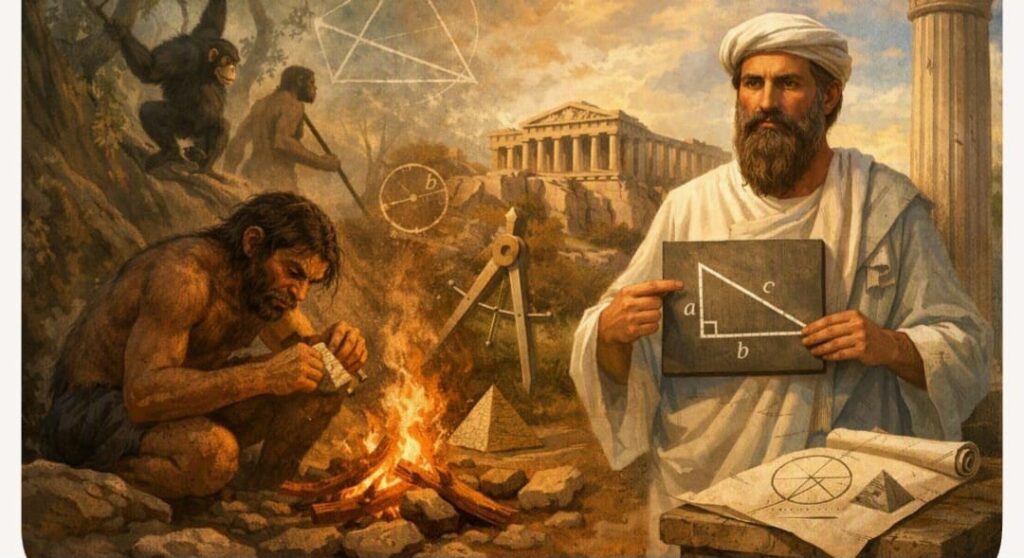
Geometry is often celebrated as the crown jewel of human intellect, a discipline of proofs, theorems, and elegant abstractions. We imagine Euclid in ancient Greece, carefully systematizing axioms, or Pythagoras proclaiming the harmony of numbers through triangles. Yet the true origins of geometry lie far deeper, in the lived experiences of our pre‑Homo sapiens ancestors. Long before civilization, long before writing, geometry was already alive — not as theory, but as instinct, as survival, as the quiet calculations of primates leaping through forests and hominins shaping stone.
Consider the primates who preceded us. A monkey gauging the distance between branches is performing geometry, even if unconsciously. Chimpanzees selecting sticks of the right length and angle to extract termites show an intuitive grasp of measurement. Orangutans navigating tangled canopies reveal an ability to plan routes through complex three‑dimensional space. These acts are not abstract mathematics, but they are geometry in its rawest form: the instinctive understanding of shape, distance, and proportion necessary for survival.
As hominins evolved, this spatial intelligence deepened. Australopithecus walked upright, a shift that demanded new awareness of balance and movement. Homo erectus shaped stone tools with deliberate edges, arranged firewood efficiently, and migrated across landscapes, all acts requiring geometric reasoning. Fire itself was a geometric revolution: arranging logs into a stable structure, controlling airflow, and creating hearths demanded spatial planning. These were not abstract theorems, but practical geometry — the kind that kept our ancestors alive.
By the time of Neanderthals and Denisovans, geometry had become cultural. Archaeological sites reveal hearths carefully constructed, shelters built with intentional proportions, and carvings with repeating patterns. These extinct cousins of ours were not mathematicians in the formal sense, but they understood symmetry, balance, and design. Their geometry was lived, not written — a language of survival expressed in stone, wood, and fire.
The leap from instinct to abstraction came with Homo sapiens. Our species transformed intuitive geometry into symbolic thought. Early humans painted symmetrical figures on cave walls, carved repeating motifs, and aligned structures with celestial bodies. In Egypt, geometry became indispensable for measuring land after the Nile’s floods and for constructing pyramids whose angles still astonish us. In Mesopotamia, clay tablets recorded calculations of areas and volumes, showing how agriculture, architecture, and trade demanded reliable methods of measurement. What began as survival instincts matured into structured knowledge, proof, and abstraction.
It is here that Pythagoras enters the story. Born around 570 BCE, Pythagoras believed that numbers and geometry revealed the hidden harmony of the universe. The famous Pythagorean theorem — that the square of the hypotenuse equals the sum of the squares of the other two sides — became a cornerstone of geometry, though its roots stretch back to Babylonian and Indian traditions centuries earlier. What Pythagoras contributed was not merely a formula but a philosophy: the conviction that geometry was more than practical measurement, that it was a window into cosmic order. His school in Croton treated mathematics as sacred, blending geometry with music, ethics, and metaphysics. In this way, Pythagoras gave geometry its soul, while Euclid later gave it its scaffolding.
Euclid, writing in the third century BCE, codified geometry into a logical system in his Elements. He offered proofs, axioms, and theorems that transformed geometry into a discipline of clarity and rigor. If Pythagoras linked geometry to mystical harmony, Euclid anchored it in reason. Together, they represent two complementary traditions: one that sees geometry as a bridge to the divine, and another that sees it as the architecture of logic.
Yet even in its most formalized form, geometry carries echoes of its origins. The circle, triangle, and square were not inventions but codifications of shapes long observed in nature and used in daily life. Euclid’s Elements may have given geometry its intellectual framework, but the raw material had been accumulating for millions of years in the minds and behaviors of our ancestors. Geometry is not merely a human invention; it is an evolutionary inheritance.
This perspective matters. Too often, we treat mathematics as a detached discipline, divorced from the messy realities of survival. But geometry is not just about proofs on paper; it is about the leap of a primate, the strike of a stone, the construction of a hearth. Recognizing this lineage enriches our understanding of mathematics and reconnects it to the lived experiences of those who came before us. It reminds us that knowledge is not created in isolation but emerges gradually, shaped by biology, environment, and necessity.
In an age where we marvel at advanced mathematics and its applications in technology, we should pause to honor the geometry of our ancestors. Their instincts for space and proportion were the first drafts of the discipline we now revere. Without their leaps, strikes, and fires, there would be no pyramids, no proofs, no modern science. Geometry is not just a triumph of civilization; it is a chronicle of survival turned into knowledge, of instinct refined into abstraction, and of humanity’s enduring quest to understand and shape the world. OT
Leave a Reply